
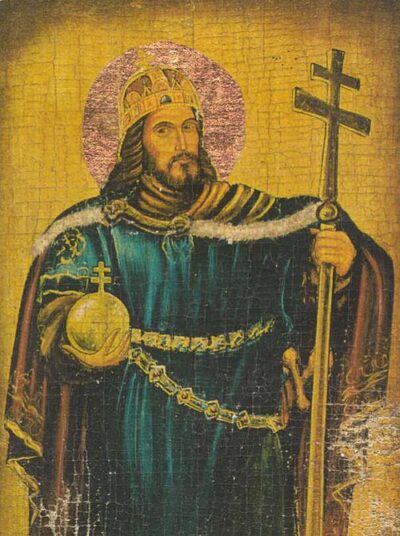
Stephen I of Hungary
Stephen I of Hungary was the 11th-century king of Hungary and saint. Born 975, in Esztergom. Died August 15, 1038, in Szentkirály (Esztergom). Positions held include Apostolic King of Hungary (1000–1038).
Facts
20 facts · 2 confirmed by two sources · 2 cited · 15 from one source · 1 where the sources disagree
What’s different
- Buried in: we show Székesfehérvár Basilica (Sources disagree). Wikidata also lists Székesfehérvár
Where this comes from
Papalocal keeps its own record. It started from these sources; what each one said is kept here as it was copied, so a change on their side never changes this page by itself. Tap one to read its version.
What Wikidata says · copied November 16, 2026 · revision 2567068561
- Described as
- 11th-century king of Hungary and saint
- Other names
- St. Stephen I Arpád, King of Hungary, Saint Stephen the King, St. Stephen the King, Vajk
- Born
- 975 · 2 references
- Died
- August 15, 1038 · 2 references
- Born in
- Esztergom
- Died in
- Szentkirály (Esztergom)
- Buried in
- Székesfehérvár Basilica; Székesfehérvár
- Citizen of
- Hungary
- Occupation
- monarch
- Positions held
- Apostolic King of Hungary (1000–1038)
- Spouse
- Gisela of Hungary (996–) · 1 reference
- Children
- Saint Emeric of Hungary; Otto, Prince of Hungary; Hedwig of Hungary · 1 reference
- Father
- Géza · 1 reference
- Mother
- Sarolt
- Siblings
- Gizella of Hungary; Judith of Hungary; Grimelda of Hungary · 1 reference; Sarolta; Hungarian wife of Gavril Radomir · 1 reference
- Religion
- Christianity
- Wikipedias with a page
- 73
Wikidata item Q177903 (wikidata.org/wiki/Q177903), public domain (CC0). Copied November 16, 2026.
What Wikipedia says · copied November 16, 2026 · revision 1378645003
Stephen I, also known as King Saint Stephen (Hungarian: Szent István király [ˌsɛnt ˈiʃtvaːn kiraːj]; Latin: Sanctus Stephanus; Slovak: Štefan I. or Štefan Veľký; c. 975 – 15 August 1038), was the last grand prince of the Hungarians between 997 and 1000 or 1001, and the first king of Hungary from 1000 or 1001 until his death in 1038. The year of his birth is uncertain, but many details of his life suggest that he was born in, or after, 975, in Esztergom. He was given the pagan name Vajk at birth, but the date of his baptism is unknown. He was the only son of Grand Prince Géza and his wife, Sarolt, who was descended from a prominent family of gyulas. Although both of his parents were baptized, Stephen was the first member of his family to become a devout Christian. He married Gisela of Bavaria, a scion of the imperial Ottonian dynasty.
After succeeding his father in 997, Stephen had to fight for the throne against his relative, Koppány, who was supported by large numbers of pagan warriors. He defeated Koppány with the assistance of foreign knights including Vecelin, Hont and Pázmány, and native lords. He was crowned on 25 December 1000 or 1 January 1001 with a crown sent by Pope Sylvester II. In a series of wars against semi-independent tribes and chieftains—including the Black Hungarians and his uncle, Gyula the Younger—he unified the Carpathian Basin. He protected the independence of his kingdom by forcing the invading troops of Conrad II, Holy Roman Emperor, to withdraw from Hungary in 1030.
Stephen established at least one archbishopric, six bishoprics and three Benedictine monasteries, leading the Church in Hungary to develop independently from the archbishops of the Holy Roman Empire. He encouraged the spread of Christianity by meting out severe punishments for ignoring Christian customs. His system of local administration was based on counties organized around fortresses and administered by royal officials. Hungary enjoyed a lasting period of peace during his reign and became a preferred route for pilgrims and merchants traveling between Western Europe, the Holy Land and Constantinople.
Stephen survived all of his children, dying on 15 August 1038, aged 62 or 63. He was buried in his new basilica, built in Székesfehérvár and dedicated to the Holy Virgin. His death was followed by civil wars which lasted for decades. He was canonized by Pope Gregory VII, together with his son Emeric and Bishop Gerard of Csanád, in 1083. Stephen is a popular saint in Hungary and neighboring territories. In Hungary, his feast day (celebrated on 20 August) is also a public holiday commemorating the foundation of the state, known as State Foundation Day.
- Born, in its opening lines
- c. 975
- Died, in its opening lines
- August 15, 1038
From the Wikipedia article “Stephen I of Hungary” (en.wikipedia.org/wiki/Stephen_I_of_Hungary), by its contributors, under CC BY-SA 4.0 (creativecommons.org/licenses/by-sa/4.0/). Copied November 16, 2026; not changed.
Confirmed Two sources agree. Cited One source, and it names where it got it. One source One source, without a reference of its own. Sources disagree The sources disagree. We show the best-supported value and keep theirs below.
