
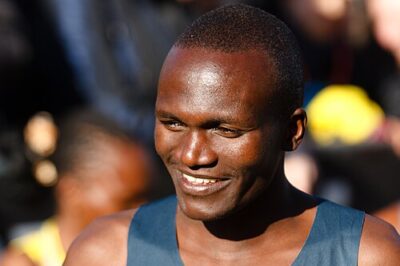
Stephen Kiprotich is an Ugandan long-distance runner. Born February 27, 1989, in Kapchorwa District.
Facts
8 facts · 1 confirmed by two sources · 4 cited · 3 from one source
Where this comes from
Papalocal keeps its own record. It started from these sources; what each one said is kept here as it was copied, so a change on their side never changes this page by itself. Tap one to read its version.
What Wikidata says · copied November 16, 2026 · revision 2568842689
- Described as
- Ugandan long-distance runner
- Born
- February 27, 1989 · 2 references
- Born in
- Kapchorwa District · 1 reference
- Citizen of
- Uganda
- Occupation
- long-distance runner · 1 reference; marathon runner · 1 reference; athletics competitor · 1 reference
- Sport
- athletics
- Height
- 1.72 m (5 ft 8 in)
- Wikipedias with a page
- 36
Wikidata item Q1702 (wikidata.org/wiki/Q1702), public domain (CC0). Copied November 16, 2026.
What Wikipedia says · copied November 16, 2026 · revision 1374501149
Stephen Kiprotich ("KIP-roh-tich", born 27 February 1989) is a Ugandan long-distance runner. He is an Olympic marathon champion, having won the gold medal at the 2012 London Olympics. Kiprotich also won a gold at the 2013 World Championships in Athletics. After Ethiopia's Gezahegne Abera, he is the second person to follow an Olympic marathon title with a world championship gold medal for the same event.
Kiprotich became 2012 Olympic champion with a winning time of 2:08:01 in hot, sunny, and humid conditions. This was the first Olympic medal for Uganda since 1996, the first Olympic gold medal for the country since 1972, and the country's first-ever medal in the marathon. He won the Moscow IAAF Championship marathon on 17 August 2013.
- Born, in its opening lines
- February 27, 1989
From the Wikipedia article “Stephen Kiprotich” (en.wikipedia.org/wiki/Stephen_Kiprotich), by its contributors, under CC BY-SA 4.0 (creativecommons.org/licenses/by-sa/4.0/). Copied November 16, 2026; not changed.
Confirmed Two sources agree. Cited One source, and it names where it got it. One source One source, without a reference of its own. Sources disagree The sources disagree. We show the best-supported value and keep theirs below.
