
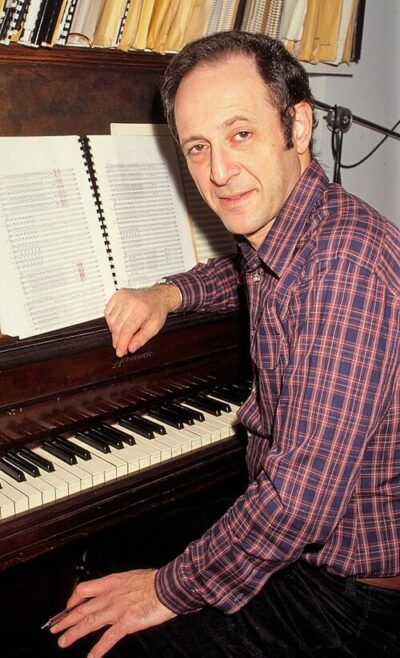
Steve Reich
Steve Reich is an American composer. Born October 3, 1936, in New York City. Known for Variations for Vibes, Piano, and Strings, Daniel Variations and Eight Lines. Educated at Mills College at Northeastern University and Juilliard School. Awards include Commandeur des Arts et des Lettres, Guggenheim Fellowship and Praemium Imperiale.
Facts
30 facts · 1 confirmed by two sources · 11 cited · 18 from one source
Where this comes from
Papalocal keeps its own record. It started from these sources; what each one said is kept here as it was copied, so a change on their side never changes this page by itself. Tap one to read its version.
What Wikidata says · copied November 13, 2026 · revision 2563857405
- Described as
- American composer (born 1936)
- Other names
- Stephen Michael Reich, Stephen Reich
- Born
- October 3, 1936 · 12 references
- Born in
- New York City · 3 references
- Name at birth
- Stephen Michael Reich
- Citizen of
- United States · 1 reference
- Occupation
- composer · 2 references; musician · 1 reference; videographer
- Education
- Mills College at Northeastern University (1961–1963) · 1 reference; Juilliard School (1958–1961) · 1 reference; Cornell University (1953–1957) · 1 reference
- Member of
- American Academy of Arts and Letters; American Academy of Arts and Sciences; Bavarian Academy of Fine Arts; Steve Reich and Musicians
- Genre
- Minimalism
- Record label
- Deutsche Grammophon; ECM Records
- Known for
- Variations for Vibes, Piano, and Strings; Daniel Variations; Eight Lines; Double Sextet
- Awards
- Commandeur des Arts et des Lettres; Guggenheim Fellowship · 1 reference; Praemium Imperiale (2006) · 1 reference; Pulitzer Prize for Music (2009) · 1 reference; BBVA Foundation Frontiers of Knowledge Award (2013); Nemmers Prize in Music Composition (2016); honorary doctor of the Royal College of Music (2016) · 1 reference
- Spouse
- Beryl Korot
- Website
- https://stevereich.com
- Wikipedias with a page
- 45
Wikidata item Q262791 (wikidata.org/wiki/Q262791), public domain (CC0). Copied November 13, 2026.
What Wikipedia says · copied November 13, 2026 · revision 1384420587
Stephen Michael Reich ( RYSHE; born October 3, 1936) is an American composer best known as a pioneer of minimal music in the mid to late 1960s. Reich's work is marked by its use of repetitive figures, slow harmonic rhythm, and canons. Reich describes this concept in his essay "Music as a Gradual Process" by stating, "I am interested in perceptible processes. I want to be able to hear the process happening throughout the sounding music." For example, his early works experiment with phase shifting, in which one or more repeated phrases plays slower or faster than the others, causing it to go "out of phase." This creates new musical patterns in a perceptible flow.
Reich's innovations include using tape loops to create phasing patterns, as on the early compositions It's Gonna Rain (1965) and Come Out (1966), and the use of simple, audible processes, as on Pendulum Music (1968) and Four Organs (1970). Works like Drumming (1971) and Music for 18 Musicians (1976), both considered landmarks of minimalism and important influences on experimental music, rock, and contemporary electronic music, would help entrench minimalism as a movement. Reich's work took on a darker character in the 1980s with the introduction of historical themes as well as themes from his Jewish heritage, notably Different Trains (1988).
Reich's style of composition has influenced many contemporary composers and groups, especially in the United States and Great Britain. The critic Andrew Clements has suggested that Reich is one of "a handful of living composers who can legitimately claim to have altered the direction of musical history".
- Born, in its opening lines
- October 3, 1936
From the Wikipedia article “Steve Reich” (en.wikipedia.org/wiki/Steve_Reich), by its contributors, under CC BY-SA 4.0 (creativecommons.org/licenses/by-sa/4.0/). Copied November 13, 2026; not changed.
Confirmed Two sources agree. Cited One source, and it names where it got it. One source One source, without a reference of its own. Sources disagree The sources disagree. We show the best-supported value and keep theirs below.
