
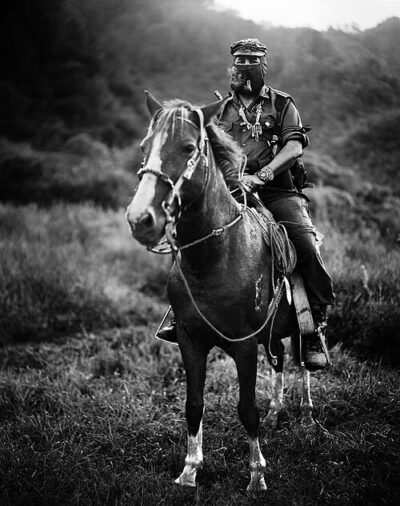
Subcomandante Marcos
Subcomandante Marcos is a Mexican activist. Born June 19, 1957, in Tampico. Known for Our Word Is Our Weapon, The Story of Colors and The Uncomfortable Dead. Educated at National Autonomous University of Mexico.
Facts
14 facts · 1 confirmed by two sources · 2 cited · 11 from one source
Where this comes from
Papalocal keeps its own record. It started from these sources; what each one said is kept here as it was copied, so a change on their side never changes this page by itself. Tap one to read its version.
What Wikidata says · copied November 16, 2026 · revision 2557896980
- Described as
- Mexican activist (1957-)
- Other names
- Subcomandante Insurgente Galeano, Subcomandante Galeano, Rafael Sebastián Guillén Vicente, Subcomandante Insurgente Marcos, Delegate Zero
- Born
- June 19, 1957 · 1 reference
- Born in
- Tampico
- Citizen of
- Mexico
- Occupation
- politician; partisan; philosopher · 1 reference; revolutionary · 1 reference; author · 1 reference
- Education
- National Autonomous University of Mexico
- Known for
- Our Word Is Our Weapon; The Story of Colors; The Uncomfortable Dead
- Siblings
- Mercedes Guillén Vicente
- Religion
- atheism
- Wikipedias with a page
- 49
Wikidata item Q491635 (wikidata.org/wiki/Q491635), public domain (CC0). Copied November 16, 2026.
What Wikipedia says · copied November 16, 2026 · revision 1380487338
Rafael Sebastián Guillén Vicente (born 19 June 1957) is a Mexican insurgent, the former military leader and spokesman for the Zapatista Army of National Liberation (EZLN) in the ongoing Chiapas conflict, and a prominent anti-capitalist and anti-neoliberal. Widely known by his initial nom de guerre Subcomandante Insurgente Marcos (frequently shortened to simply Subcomandante Marcos), he has subsequently employed several other pseudonyms: he called himself Delegate Zero during the Other Campaign (2006–2007), Subcomandante Insurgente Galeano (again, frequently with the "Insurgente" omitted) from May 2014 to October 2023, which he adopted in honor of his fallen comrade Jose Luis Solis Lopez, his nom de guerre being Galeano, aka "Teacher Galeano." and since October 2023, Capitán Insurgente Marcos. Marcos bears the title and rank of Capitán (or "Captain" in English), and before that Subcomandante, (or "Subcommander" in English), as opposed to Comandante (or "Commander" in English), because he is under the command of the indigenous commanders who constitute the EZLN's Clandestine Revolutionary Indigenous Committee's General Command (CCRI-CG in Spanish).
Born in Tampico, Tamaulipas, Marcos earned a degree from the Faculty of Philosophy and Literature at the National Autonomous University of Mexico (UNAM), and taught at the Autonomous Metropolitan University (UAM) for several years during the early 1980s. During this time he became increasingly involved with a guerrilla group known as the National Liberation Forces (FLN), before leaving the university and moving to Chiapas in 1984.
The Ejército Zapatista de Liberación Nacional (EZLN) (Zapatista Army of National Liberation; often simply called the Zapatistas) was the local Chiapas wing of FLN, founded in the Lacandon Jungle in 1983, initially functioning as a self-defense unit dedicated to protecting Chiapas' Maya people from evictions and encroachment on their land. While not Maya himself, Marcos emerged as the group's military leader, and when the EZLN, acting independently of the FLN, began its rebellion on 1 January 1994, he served as its spokesman.
Known for his trademark ski mask and pipe and for his charismatic personality, Marcos coordinated the EZLN's 1994 uprising, headed up the subsequent peace negotiations, and played a prominent role throughout the Zapatistas' struggle in the following decades. After the ceasefire the government declared on day 12 of the revolt, the Zapatistas transitioned from revolutionary guerrillas to an armed social movement, with Marcos's role transitioning from military strategist to public relations strategist. He became the Zapatistas' spokesperson and interface with the public, penning communiqués, holding press conferences, hosting gatherings, granting interviews, delivering speeches, devising plebiscites, organizing marches, orchestrating campaigns, and twice touring Mexico, all to attract national and international media attention and public support for the Zapatistas.
In 2001, he headed a delegation of Zapatista commanders to Mexico City to deliver their message on promoting indigenous rights before the Mexican Congress, attracting widespread public and media attention. In 2006, Marcos made another public tour of Mexico, which was known as The Other Campaign. In May 2014, Marcos stated that the persona of Subcomandante Marcos had been "a hologram" and no longer existed. Many media outlets interpreted the message as Marcos retiring as the Zapatistas' military leader and spokesman.
Marcos is a prolific writer whose considerable literary talents have been widely acknowledged by prominent writers and intellectuals, with hundreds of communiqués and several books being attributed to him. Most of his writings are anti-capitalist while advocating for indigenous people's rights, but he has also written poetry, children's stories, and folktales and co-authored a crime novel. He has been hailed by Régis Debray as "the best Latin American writer today." Published translations of his writings exist in at least 14 languages.
- Born, in its opening lines
- June 19, 1957
From the Wikipedia article “Subcomandante Marcos” (en.wikipedia.org/wiki/Subcomandante_Marcos), by its contributors, under CC BY-SA 4.0 (creativecommons.org/licenses/by-sa/4.0/). Copied November 16, 2026; not changed.
Confirmed Two sources agree. Cited One source, and it names where it got it. One source One source, without a reference of its own. Sources disagree The sources disagree. We show the best-supported value and keep theirs below.
