
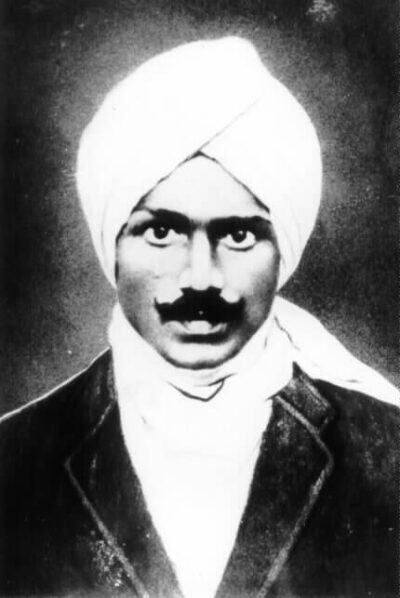
Subramanya Bharathi
Subramanya Bharathi was a Tamil poet, social reformer, fighter for Indian freedom & women's rights. Born December 11, 1882, in Ettayapuram. Died September 12, 1921, in Chennai. Known for Panjali Sabatham, Vinayakar Nanmanimalai and Gnanaratham. Educated at The Madurai Diraviyam Thayumanavar Hindu College.
Facts
19 facts · 1 confirmed by two sources · 2 cited · 15 from one source · 1 where the sources disagree
What’s different
- Died: we show September 12, 1921 (Sources disagree). Wikipedia says September 11, 1921
Where this comes from
Papalocal keeps its own record. It started from these sources; what each one said is kept here as it was copied, so a change on their side never changes this page by itself. Tap one to read its version.
What Wikidata says · copied November 16, 2026 · revision 2556982029
- Described as
- Tamil poet, social reformer, fighter for Indian freedom & women's rights
- Other names
- Bharathiar, Subramania Bharathi, Subramania Bharathiyar, Mahakavi Subramania Bharathiyar
- Born
- December 11, 1882 · 3 references
- Died
- September 12, 1921 · 3 references
- Born in
- Ettayapuram
- Died in
- Chennai
- Citizen of
- British Raj
- Occupation
- poet; journalist; autobiographer; writer · 1 reference
- Education
- The Madurai Diraviyam Thayumanavar Hindu College
- Known for
- Panjali Sabatham; Vinayakar Nanmanimalai; Gnanaratham; Vedharishigalin kavidhai; Kannan Paattu
- Spouse
- Chellamma Bharathi · 1 reference
- Children
- Thangammal Bharathi
- Religion
- Hinduism
- Lived in
- Triplicane
- Wikipedias with a page
- 31
Wikidata item Q256286 (wikidata.org/wiki/Q256286), public domain (CC0). Copied November 16, 2026.
What Wikipedia says · copied November 16, 2026 · revision 1381404478
Subramania Bharati (born Chinnaswami Subramaniyan; 11 December 1882 – 11 September 1921) was an Indian writer, poet, composer, journalist, teacher, Indian independence activist, social reformer, and polyglot. He was bestowed the title Bharati for his poetry and was a pioneer of modern Tamil poetry. He is popularly known by his title Bharati or Bharatiyar and also by the other title "Mahakavi Bharati" ("the great poet Bharati"). His works included patriotic songs composed during the Indian Independence movement. He fought for the emancipation of women, against child marriage, opposed the caste system, and advocated reforms of the society and religion.
Born in Ettayapuram, in the Tirunelveli district (present-day Thoothukudi) in 1882, Bharati had his early education in Tirunelveli. He later lived in Varanasi for sometime where he was exposed to Hindu theology and new languages. He worked as a journalist with many newspapers, including Swadesamitran, The Hindu, Bala Bharata, Vijaya, Chakravarthini and India. He considered Sister Nivedita, a disciple of Swami Vivekananda, as his guru.
In 1908, the British Government issued an arrest warrant for Bharati which pushed him to live in exile in the French-controlled Pondicherry for about ten years until 1918. He was attacked by an Indian elephant at Thiruvallikeni Parthasarathy Temple whom he fed daily and died a few months later on 11 September 1921.
Bharati was well-versed in several languages and had a deep passion for Tamil. His works covered political, social and spiritual themes. Songs and poems composed by Bharati are widely used in Tamil literature, music and daily life. His works include Panjali Sabatham, Kannan Paatu, Kuyil Paatu, Paapa Paatu, Chinnanchriu Kiliye, Vinayagar Nanmanimalai and Tamil translations of Patanjali's Yoga Sutra and Bhagavat Gita. Bharati was the first poet whose literature was nationalized in 1949.
- Born, in its opening lines
- December 11, 1882
- Died, in its opening lines
- September 11, 1921
From the Wikipedia article “Subramania Bharati” (en.wikipedia.org/wiki/Subramania_Bharati), by its contributors, under CC BY-SA 4.0 (creativecommons.org/licenses/by-sa/4.0/). Copied November 16, 2026; not changed.
Confirmed Two sources agree. Cited One source, and it names where it got it. One source One source, without a reference of its own. Sources disagree The sources disagree. We show the best-supported value and keep theirs below.
