
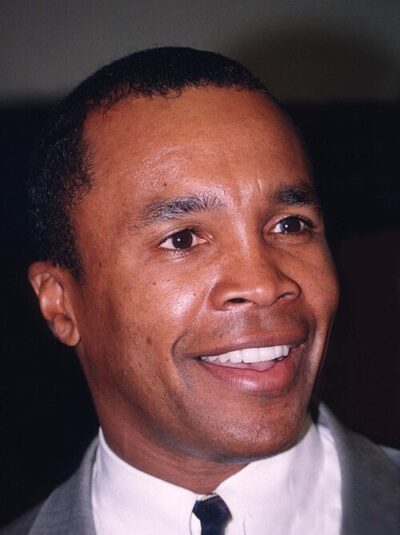
Sugar Ray Leonard
Sugar Ray Leonard is an American boxer. Born May 17, 1956, in Wilmington. Educated at Parkdale High School. Awards include International Boxing Hall of Fame, WBC World Light Heavyweight Champion and WBC World Super Middleweight Champion.
Facts
22 facts · 1 confirmed by two sources · 13 cited · 8 from one source
Where this comes from
Papalocal keeps its own record. It started from these sources; what each one said is kept here as it was copied, so a change on their side never changes this page by itself. Tap one to read its version.
What Wikidata says · copied November 13, 2026 · revision 2562744487
- Described as
- American boxer
- Other names
- Ray Charles Leonard
- Born
- May 17, 1956 · 4 references
- Born in
- Wilmington · 2 references
- Citizen of
- United States
- Occupation
- boxer · 1 reference; actor
- Education
- Parkdale High School · 1 reference
- Sport
- boxing
- Awards
- International Boxing Hall of Fame (1997) · 1 reference; WBC World Light Heavyweight Champion (1988) · 1 reference; WBC World Super Middleweight Champion (1988–1990) · 1 reference; WBC World Middleweight Champion (1987) · 1 reference; WBC World Welterweight Champion (1979–1982) · 1 reference; WBA World Super Welterweight Champion (1981) · 1 reference; WBA World Welterweight Champion (1981–1982) · 1 reference; The Ring World Middleweight Champion (1987) · 1 reference; The Ring World Junior Middleweight Champion (1981–1982) · 1 reference; The Ring World Welterweight Champion (1979–1982) · 1 reference; Sugar Ray Robinson Award (3 times) (1976, 1979, 1981) · 1 reference; The Ring magazine Fighter of the Year (2 times) (1979, 1981) · 1 reference
- Spouse
- Bernadette Robi (1993–) · 1 reference
- Height
- 1.79 m (5 ft 11 in)
- Website
- https://www.sugarrayleonard.com/
- Wikipedias with a page
- 45
Wikidata item Q335798 (wikidata.org/wiki/Q335798), public domain (CC0). Copied November 13, 2026.
What Wikipedia says · copied November 13, 2026 · revision 1380569651
Ray Charles Leonard (born May 17, 1956), better known as Sugar Ray Leonard, is an American former professional boxer. Often regarded as one of the greatest boxers of all time, he competed professionally between 1976 and 1997, winning world titles in five weight classes; the lineal championship in three weight classes; as well as the undisputed welterweight championship. Leonard was part of the "Four Kings", a group of boxers who all fought each other throughout the 1980s, consisting of Leonard, Roberto Durán, Thomas Hearns, and Marvin Hagler. Leonard was the only one of them to beat the other three. As an amateur, Leonard won a light welterweight gold medal at the 1976 Summer Olympics.
The "Four Kings" created a wave of popularity in the lower weight classes that kept boxing relevant in the post-Muhammad Ali era, during which Leonard defeated future fellow International Boxing Hall of Fame inductees Hearns, Durán, Hagler, and Wilfred Benítez. Leonard was also the first boxer to earn more than $100 million in purses, and was named "Boxer of the Decade" in the 1980s. The Ring magazine named him Fighter of the Year in 1979 and 1981, while the Boxing Writers Association of America named him Fighter of the Year in 1976, 1979, and 1981. He was honored as the Sports Illustrated Sportsman of the Year in 1981. In 2002, Leonard was voted by The Ring as the ninth greatest fighter of the last 80 years. In 2016, he was voted by The Ring to be the greatest living fighter.
Outside his professional boxing career, Leonard has worked as a boxing analyst and actor, appearing in numerous television shows and films, including Half & Half, L.A. Heat, Married... with Children, Renegade, Tales from the Crypt, I Spy (2002), and The Fighter (2010).
- Born, in its opening lines
- May 17, 1956
From the Wikipedia article “Sugar Ray Leonard” (en.wikipedia.org/wiki/Sugar_Ray_Leonard), by its contributors, under CC BY-SA 4.0 (creativecommons.org/licenses/by-sa/4.0/). Copied November 13, 2026; not changed.
Confirmed Two sources agree. Cited One source, and it names where it got it. One source One source, without a reference of its own. Sources disagree The sources disagree. We show the best-supported value and keep theirs below.
