
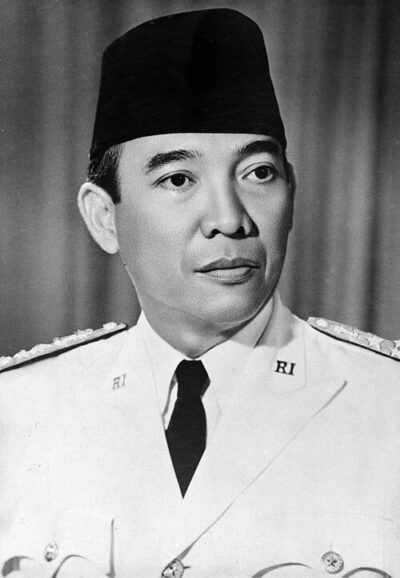
Sukarno
Sukarno was the 1st President of Indonesia (1901—1970). Born June 6, 1901, in Surabaya. Died June 21, 1970, in Jakarta. Positions held include President of Indonesia (1945–1967) and Prime Minister of Indonesia (1959–1966). Educated at Technische Hoogeschool te Bandoeng. Awards include Order of Lenin, National Hero of Indonesia and Lenin Peace Prize.
Facts
51 facts · 2 confirmed by two sources · 14 cited · 35 from one source
Where this comes from
Papalocal keeps its own record. It started from these sources; what each one said is kept here as it was copied, so a change on their side never changes this page by itself. Tap one to read its version.
What Wikidata says · copied November 16, 2026 · revision 2568152319
- Described as
- 1st President of Indonesia (1901—1970)
- Other names
- Kusno Sosrodihardjo, Achmed Soekarno, Ir. Soekarno, Bung Karno, Soekarno
- Born
- June 6, 1901 · 9 references
- Died
- June 21, 1970 · 9 references
- Born in
- Surabaya · 2 references
- Died in
- Jakarta · 2 references
- Buried in
- Grave of Sukarno · 1 reference
- Cause of death
- kidney failure
- Name at birth
- Kusno Sosrodihardjo · 1 reference
- Citizen of
- Indonesia · 1 reference; Dutch East Indies
- Occupation
- politician · 1 reference; art collector · 1 reference
- Positions held
- President of Indonesia (1945–1967); Prime Minister of Indonesia (1959–1966)
- Political party
- Indonesian National Party (1927–1931) · 1 reference
- Education
- Technische Hoogeschool te Bandoeng (1922–1926) · 1 reference
- Member of
- Bandung Study Club · 1 reference
- Awards
- Order of Lenin (1956) · 1 reference; National Hero of Indonesia (2012) · 1 reference; Lenin Peace Prize (1960); Grand Cross of the Order of the Condor of the Andes (1955) · 1 reference; Order of Georgi Dimitrov (1960); honorary doctor of Sofia University (1960); Grand Cross Special Class of the Order of Merit of the Federal Republic of Germany; Grand Cross of the Order of Chula Chom Klao; Resistance Order, 1st class · 1 reference; Order of the National Flag, 1st class · 1 reference; Star of the Republic of Indonesia · 1 reference; Benemerenti medal · 1 reference; Order of the Flag of the People's Republic of Hungary · 1 reference; Order of the Queen of Sheba · 1 reference; Order of the Star of Ghana · 1 reference
- Spouse
- Siti Oetari (1921–1923); Inggit Garnasih (1923–1942); Fatmawati (1943–1956); Hartini (1953–); Kartini Manoppo (1959–1968); Dewi Sukarno (1962–)
- Children
- Guntur Soekarnoputra; Megawati Soekarnoputri · 1 reference; Taufan Sukarnoputra; Sukmawati Soekarnoputri · 1 reference; Guruh Sukarnoputra · 1 reference; Rachmawati Sukarnoputri; Bayu Sukarnoputra; Toto Suryawan; Kartika Sari Dewi Soekarno; Ayu Gembirowati
- Father
- Soekemi Sosrodihardjo
- Mother
- Ida Ayu Nyoman Rai
- Religion
- Islam
- Height
- 1.72 m (5 ft 8 in) · 1 reference
- Wikipedias with a page
- 129
Wikidata item Q76127 (wikidata.org/wiki/Q76127), public domain (CC0). Copied November 16, 2026.
What Wikipedia says · copied November 16, 2026 · revision 1385748277
Sukarno (born Koesno Sosrodihardjo; 6 June 1901 – 21 June 1970) was an Indonesian statesman, activist, and revolutionary who served as the first president of Indonesia from 1945 to 1967.
Sukarno was the leader of the Indonesian struggle for independence from the Dutch colonialists. He was a prominent leader of Indonesia's nationalist movement during the colonial period and spent over a decade under Dutch detention until released by the invading Japanese forces in World War II. Sukarno and his fellow nationalists collaborated to garner support for the Japanese war effort from the population, in exchange for Japanese aid in spreading nationalist ideas. Upon Japanese surrender, Sukarno and Mohammad Hatta declared Indonesian independence on 17 August 1945, and Sukarno was appointed president. He led the Indonesian resistance to Dutch re-colonisation efforts via diplomatic and military means until the Dutch recognition of Indonesian independence in 1949. As a result, he was given the title "Father of Proclamation" (Indonesian: Bapak Proklamator).
After a tumultuous period of parliamentary democracy, Sukarno introduced an authoritarian system known as "Guided Democracy" in 1959 to restore stability and suppress regional rebellions. By the early 1960s, Sukarno pursued an aggressive foreign policy and positioned Indonesia as a leading voice in the anti-imperialist Non-Aligned Movement (NAM). These policies increased tensions with Western powers and brought Indonesia closer to the Soviet Union, despite being a non-communist state. The culmination of this policy was CONEFO, Sukarno's plan for a new United Nations based in Jakarta.
On 1st October 1965, following the events of the 30 September Movement, a coup attempt allegedly orchestrated by senior leaders in the Communist Party of Indonesia (PKI), General Suharto assumed control of the government in a military takeover. This was accompanied by a large-scale anti-communist purge backed by Western intelligence agencies including from the United States and the United Kingdom. Between 500,000 and over 1 million people were killed in mass killings targeting members and suspected sympathisers of the PKI.
Suharto officially became president in 1967, while Sukarno was placed under house arrest until his death in 1970. He was buried in Blitar, East Java, next to his mother. During the first few years of Suharto's New Order regime, Sukarno's role in the country's independence and his earlier achievements were minimized, and his name was largely removed from public discourse. However, as opposition against Suharto increased with his eventual fall in 1998, public interest in Sukarno was revived in tandem to democratic reforms. Today, his legacy as the founding father of Indonesia and a symbol of national unity and independence continues to be widely respected by many Indonesians, often more so than that of Suharto.
- Born, in its opening lines
- June 6, 1901
- Died, in its opening lines
- June 21, 1970
From the Wikipedia article “Sukarno” (en.wikipedia.org/wiki/Sukarno), by its contributors, under CC BY-SA 4.0 (creativecommons.org/licenses/by-sa/4.0/). Copied November 16, 2026; not changed.
Confirmed Two sources agree. Cited One source, and it names where it got it. One source One source, without a reference of its own. Sources disagree The sources disagree. We show the best-supported value and keep theirs below.
