
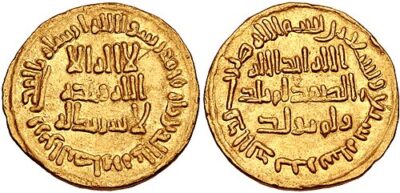
Sulayman ibn Abd al-Malik
Sulayman ibn Abd al-Malik was an Umayyad caliph. Born 675, in Medina. Died September 24, 717, in Dabiq. Positions held include Umayyad Caliph (715–717).
Facts
25 facts · 2 confirmed by two sources · 0 cited · 23 from one source
Where this comes from
Papalocal keeps its own record. It started from these sources; what each one said is kept here as it was copied, so a change on their side never changes this page by itself. Tap one to read its version.
What Wikidata says · copied November 16, 2026 · revision 2560487520
- Described as
- Umayyad caliph
- Born
- 675
- Died
- September 24, 717
- Born in
- Medina
- Died in
- Dabiq
- Citizen of
- Umayyad Caliphate
- Occupation
- military leader; politician; governor; caliph
- Positions held
- Umayyad Caliph (715–717)
- Children
- Abd al-Wahid ibn Sulayman; Ayub bin Suleiman
- Father
- Abd al-Malik ibn Marwan
- Mother
- Wallada bint al-Abbas ibn al-Jaz
- Siblings
- Hisham ibn Abd al-Malik; Al-Walid I; Yazid II; Maslamah ibn Abd al-Malik; Fatima bint Abd al-Malik; Marwan ibn Abd al-Malik; Abdallah ibn Abd al-Malik; Muhammad ibn Abd al-Malik ibn Marwan; Sa'id ibn Abd al-Malik; Bakkar ibn Abd al-Malik
- Religion
- Islam
- Wikipedias with a page
- 52
Wikidata item Q284233 (wikidata.org/wiki/Q284233), public domain (CC0). Copied November 16, 2026.
What Wikipedia says · copied November 16, 2026 · revision 1383027268
Sulayman ibn Abd al-Malik ibn Marwan (c. 675 – 24 September 717) was the seventh Umayyad caliph, ruling from 715 until his death. He began his career as governor of Palestine during the reigns of his father Abd al-Malik (r. 685–705) and brother al-Walid I (r. 705–715). The theologian Raja ibn Haywa mentored him and he forged close ties with Yazid ibn al-Muhallab, a major opponent of al-Hajjaj ibn Yusuf, al-Walid's powerful viceroy of Iraq and the eastern Caliphate. Sulayman resented al-Hajjaj's influence over his brother. As governor, Sulayman founded the city of Ramla and built the White Mosque in it. The new city superseded Lydda as the district capital of Palestine. Lydda was at least partly destroyed and its inhabitants may have been forcibly relocated to Ramla, which developed into an economic hub, became home to many Muslim scholars, and remained the commercial and administrative center of Palestine until the 11th century.
After acceding as caliph, Sulayman dismissed his predecessor's governors and generals. Many had been handpicked by al-Hajjaj and had led the war efforts which brought the Caliphate to its greatest territorial extent. Among them were the conqueror of Transoxiana (Central Asia), Qutayba ibn Muslim, who was killed by his own troops in an abortive revolt in anticipation of his dismissal, and the conqueror of Sind (the western Indian subcontinent), Muhammad ibn al-Qasim, who was executed. In the west, Sulayman deposed Musa ibn Nusayr, the conqueror of the Iberian Peninsula (al-Andalus) and governor of Ifriqiya (central North Africa), and had his son Abd al-Aziz, governor of al-Andalus, assassinated. Although he continued his predecessors' militarist policies, expansion largely stopped under Sulayman, partly due to effective resistance along the Central Asian frontiers and the collapse of Arab military leadership and organization there after Qutayba's death. Sulayman's appointee over the eastern Caliphate, his confidant Yazid, invaded the southern Caspian coast in 716, but withdrew and settled for a tributary arrangement after being defeated by the local Iranian rulers. Sulayman intensified the war with the Byzantine Empire, the primary focus of his war efforts, culminating in the 717–718 siege of Constantinople, which ended in a disastrous Arab defeat.
Sulayman died in Dabiq during the siege. His eldest son and chosen successor, Ayyub, had predeceased him. Sulayman made the unconventional choice of nominating his cousin, Umar, as caliph, rather than a son or a brother. The siege of Constantinople and the coinciding of his reign with the approaching centennial of the Hijra (start of the Islamic calendar), led contemporary Arab poets to view Sulayman in messianic terms.
- Born, in its opening lines
- c. 675
- Died, in its opening lines
- September 24, 717
From the Wikipedia article “Sulayman ibn Abd al-Malik” (en.wikipedia.org/wiki/Sulayman_ibn_Abd_al-Malik), by its contributors, under CC BY-SA 4.0 (creativecommons.org/licenses/by-sa/4.0/). Copied November 16, 2026; not changed.
Confirmed Two sources agree. Cited One source, and it names where it got it. One source One source, without a reference of its own. Sources disagree The sources disagree. We show the best-supported value and keep theirs below.
