
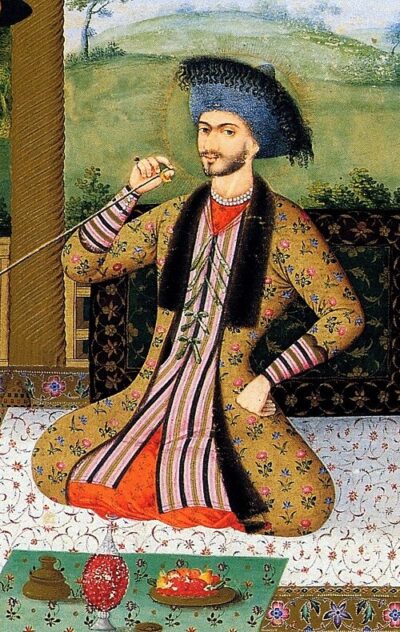
Suleiman I of Persia
Suleiman I of Persia was The eighth Safavid shah. Born 1648, in Isfahan. Died July 29, 1694, in Isfahan. Positions held include list of Safavid monarchs (1666–1694).
Facts
12 facts · 2 confirmed by two sources · 0 cited · 10 from one source
Where this comes from
Papalocal keeps its own record. It started from these sources; what each one said is kept here as it was copied, so a change on their side never changes this page by itself. Tap one to read its version.
What Wikidata says · copied November 16, 2026 · revision 2553832231
- Described as
- The eighth Safavid shah (1666–1694)
- Other names
- Suleiman I, Sam Mirzā
- Born
- 1648
- Died
- July 29, 1694
- Born in
- Isfahan
- Died in
- Isfahan
- Buried in
- Fatima Masumeh Shrine
- Positions held
- list of Safavid monarchs (1666–1694)
- Spouse
- Elena Khanum
- Children
- Sultan Husayn; Shahbanu Begum Safavi
- Father
- Abbas II of Persia
- Mother
- Nakihat Khanum · 1 reference
- Religion
- Islam
- Wikipedias with a page
- 39
Wikidata item Q210704 (wikidata.org/wiki/Q210704), public domain (CC0). Copied November 16, 2026.
What Wikipedia says · copied November 16, 2026 · revision 1380030096
Suleiman I (Persian: شاه سلیمان, romanized: Shah Solayman; born Sam Mirza, February or March 1648 – 29 July 1694) was the eighth Shah of Safavid Iran from 1666 to 1694. He was the eldest son of Abbas II and his concubine, Nakihat Khanum. Born as Sam Mirza, Suleiman spent his childhood in the harem among women and eunuchs and his existence was hidden from the public. In 1666, after the death of his father, the nineteen-year-old Sam Mirza was crowned king under the regnal name, Safi II, after his grandfather, Safi I. He had a troublesome reign as Safi II, which convinced his court astrologers that he should undergo a coronation once again. Thus, in 20 March 1668, simultaneously with Nowruz, he was crowned king with a new name, Suleiman I.
After his second coronation, Suleiman retreated into his harem to enjoy sexual activities and excessive drinking. He was indifferent to the state affairs, and often would not appear in the public for months. Suleiman's reign was devoid of spectacular events in the form of major wars and rebellions. For this reason, Western contemporary historians regard Suleiman's reign as "remarkable for nothing" while the Safavid court chronicles refrained from recording his tenure. Suleiman's reign saw the decline of the Safavid army, to the point when the soldiers became undisciplined and made no effort to serve as it was required of them. At the same time, the eastern borders of the realm were under the constant raids from the Uzbeks, and the Kalmyks.
On 29 July 1694, Suleiman died from a combination of gout and his chronic alcoholism. Often seen as a failure in kingship, Suleiman's reign was the starting point of the Safavid ultimate decline: weakened military power, falling agricultural output and the corrupt bureaucracy, all were a forewarning of the troubling rule of his successor, Soltan Hoseyn, whose reign saw the end of the Safavid dynasty. Suleiman was the first Safavid Shah that did not patrol his kingdom and never led an army, thus giving away the government affairs to the influential court eunuchs, harem women and the Shi‘i high clergy. Perhaps the only admiring aspect of his reign was the appreciation of art, for the Farangi-Sazi, or the Western painting style, saw its establishment under Suleiman's sponsorship.
- Born, in its opening lines
- March 1648
- Died, in its opening lines
- July 29, 1694
From the Wikipedia article “Suleiman I of Persia” (en.wikipedia.org/wiki/Suleiman_I_of_Persia), by its contributors, under CC BY-SA 4.0 (creativecommons.org/licenses/by-sa/4.0/). Copied November 16, 2026; not changed.
Confirmed Two sources agree. Cited One source, and it names where it got it. One source One source, without a reference of its own. Sources disagree The sources disagree. We show the best-supported value and keep theirs below.
