
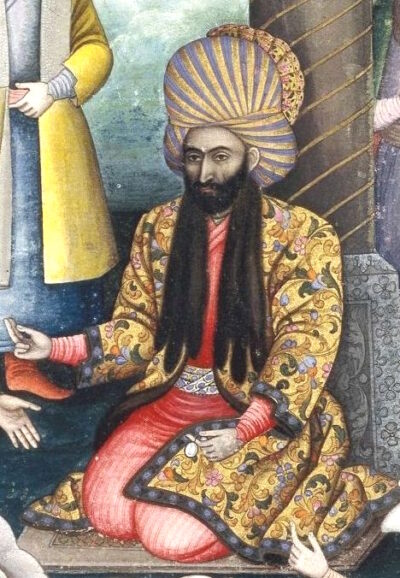
Sultan Husayn
Sultan Husayn was The ninth Safavid king. Born 1668, in Isfahan. Died 1726, in Isfahan. Positions held include list of Safavid monarchs (1694–1722).
Facts
17 facts · 1 confirmed by two sources · 2 cited · 13 from one source · 1 where the sources disagree
What’s different
- Died: we show 1726 (Sources disagree). Wikipedia says September 9, 1727
Where this comes from
Papalocal keeps its own record. It started from these sources; what each one said is kept here as it was copied, so a change on their side never changes this page by itself. Tap one to read its version.
What Wikidata says · copied November 16, 2026 · revision 2558710624
- Described as
- The ninth Safavid king (1694–1722)
- Other names
- Soltan Hoseyn I
- Born
- 1668 · 4 references
- Died
- 1726 · 4 references
- Born in
- Isfahan
- Died in
- Isfahan
- Buried in
- Fatima Masumeh Shrine · 1 reference
- Cause of death
- decapitation
- Citizen of
- Safavid Iran
- Occupation
- sovereign · 1 reference; king · 1 reference
- Positions held
- list of Safavid monarchs (1694–1722)
- Children
- Tahmasp II; Raziya Sultan; Maryam Begum Safavi
- Father
- Suleiman I of Persia
- Mother
- Elena Khanum
- Siblings
- Shahrbanu Begum
- Religion
- Islam
- Wikipedias with a page
- 41
Wikidata item Q446965 (wikidata.org/wiki/Q446965), public domain (CC0). Copied November 16, 2026.
What Wikipedia says · copied November 16, 2026 · revision 1377038494
Soltan Hoseyn (Persian: سلطان حسین, romanized: Soltān-Hoseyn; 1668 – 9 September 1727) was the Safavid shah of Iran from 1694 to 1722. He was the son and successor of Shah Suleiman (r. 1666–1694).
Born and raised in the royal harem, Soltan Hoseyn ascended the throne with limited life experience and more or less no expertise in the affairs of the country. He was installed on the throne through the efforts of his powerful great-aunt, Maryam Begum, as well as the court eunuchs, who wanted to increase their authority by taking advantage of a weak and impressionable ruler. Throughout his reign, Soltan Hoseyn became known for his extreme devotion, which had blended with his superstition, impressionable personality, excessive pursuit of pleasure, debauchery, and wastefulness, all of which have been considered by both contemporary and later writers as elements that played a part in the decline of the country.
The last decade of Soltan Hoseyn's reign was marked by urban dissension, tribal uprisings, and encroachment by the country's neighbours. The biggest threat came from the east, where the Afghans had rebelled under the leadership of the warlord Mirwais Hotak. The latter's son and successor, Mahmud Hotak, made an incursion into the country's centre, eventually reaching the capital Isfahan in 1722, which was put under siege. The city was soon struck by famine, which forced Soltan Hoseyn to surrender on 21 October 1722. He relinquished his regalia to Mahmud Hotak, who subsequently had him imprisoned, and became the new ruler of the city. In November, Soltan Hoseyn's third son and heir apparent declared himself as Tahmasp II in the city of Qazvin.
Soltan Hoseyn was beheaded on 9 September 1727 under the orders of Mahmud Hotak's successor Ashraf Hotak (r. 1725–1729), due to an insulting letter sent by the Ottoman commander-in-chief Ahmad Pasha, who claimed that he had marched into Iran in order to restore Soltan Hoseyn to the throne.
- Born, in its opening lines
- 1668
- Died, in its opening lines
- September 9, 1727
From the Wikipedia article “Soltan Hoseyn” (en.wikipedia.org/wiki/Soltan_Hoseyn), by its contributors, under CC BY-SA 4.0 (creativecommons.org/licenses/by-sa/4.0/). Copied November 16, 2026; not changed.
Confirmed Two sources agree. Cited One source, and it names where it got it. One source One source, without a reference of its own. Sources disagree The sources disagree. We show the best-supported value and keep theirs below.
