
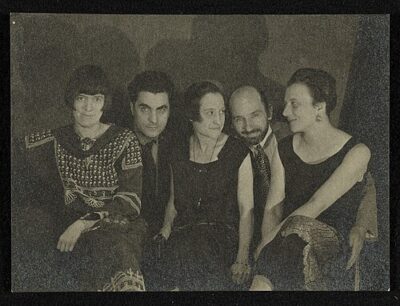
Suzanne Duchamp
Suzanne Duchamp was a French Dadaist painter. Born October 20, 1889, in Blainville-Crevon. Died September 11, 1963, in Paris. Educated at École supérieure d'art et design Le Havre-Rouen.
Facts
15 facts · 2 confirmed by two sources · 6 cited · 7 from one source
Where this comes from
Papalocal keeps its own record. It started from these sources; what each one said is kept here as it was copied, so a change on their side never changes this page by itself. Tap one to read its version.
What Wikidata says · copied November 18, 2026 · revision 2565529697
- Described as
- French Dadaist painter (1889-1963)
- Other names
- Suzanne Duchamp-Crotti, Suzanne Duchamp Crotti, Suzanne Crotti-Duchamp, Suzanne Crotti
- Born
- October 20, 1889 · 5 references
- Died
- September 11, 1963 · 4 references
- Born in
- Blainville-Crevon
- Died in
- Paris
- Buried in
- Cimetière monumental de Rouen
- Citizen of
- France · 1 reference
- Occupation
- painter · 2 references
- Education
- École supérieure d'art et design Le Havre-Rouen
- Field
- painting
- Spouse
- Jean Crotti · 1 reference
- Father
- Justin-Isidore Eugène Duchamp
- Mother
- Lucie Duchamp
- Siblings
- Raymond Duchamp-Villon · 1 reference; Jacques Villon · 1 reference; Marcel Duchamp · 1 reference
- Wikipedias with a page
- 20
Wikidata item Q435558 (wikidata.org/wiki/Q435558), public domain (CC0). Copied November 18, 2026.
What Wikipedia says · copied November 18, 2026 · revision 1382691316
Suzanne Duchamp-Crotti (20 October 1889 – 11 September 1963) was a French Dadaist painter, collagist, sculptor, and draughtsman. Her work was significant to the development of Paris Dada and modernism and her drawings and collages explore fascinating gender dynamics. Because she was a woman in the male-dominated Dada movement, she was rarely considered an artist in her own right. She was constantly overshadowed by her famous older brothers, who were also artists, or was often reduced to being described simply as "the wife of" fellow artist Jean Crotti. Her work in painting turns out to be significantly influential to the landscape of Dada in Paris and to the interests of women in Dada. She took a large role as an avant-garde artist, working through a career that spanned five decades, during a turbulent time of great societal change. She used her work to express certain subject matter such as personal concerns about modern society, her role as a modern woman artist, and the effects of the First World War. Her work often weaves painting, collage, and language together in complex ways.
- Born, in its opening lines
- October 20, 1889
- Died, in its opening lines
- September 11, 1963
From the Wikipedia article “Suzanne Duchamp” (en.wikipedia.org/wiki/Suzanne_Duchamp), by its contributors, under CC BY-SA 4.0 (creativecommons.org/licenses/by-sa/4.0/). Copied November 18, 2026; not changed.
Confirmed Two sources agree. Cited One source, and it names where it got it. One source One source, without a reference of its own. Sources disagree The sources disagree. We show the best-supported value and keep theirs below.
