
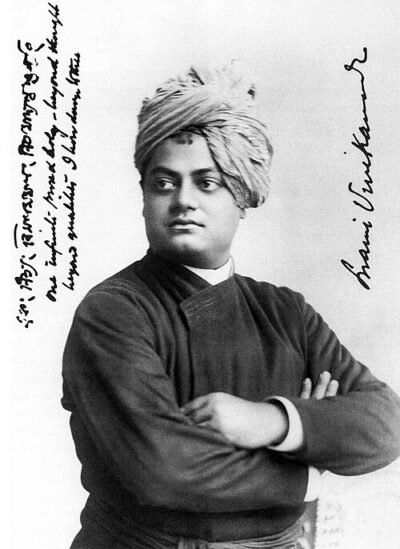
Swami Vivekananda
Swami Vivekananda was an Indian Hindu monk and philosopher. Born January 12, 1863, in Swami Vivekananda's Ancestral House & Cultural Centre. Died July 4, 1902, in Belur. Known for Bartaman Bharat, Raja Yoga and Jnana Yoga. Educated at Presidency University and Scottish Church College.
Facts
32 facts · 2 confirmed by two sources · 13 cited · 15 from one source · 2 where the sources disagree
What’s different
- Born in: we show Swami Vivekananda's Ancestral House & Cultural Centre (Sources disagree). Wikidata also lists Kolkata
- Name at birth: we show নরেন্দ্রনাথ দত্ত (Sources disagree). Wikidata also lists नरेन्द्रनाथ दत्त
Where this comes from
Papalocal keeps its own record. It started from these sources; what each one said is kept here as it was copied, so a change on their side never changes this page by itself. Tap one to read its version.
What Wikidata says · copied November 16, 2026 · revision 2567363405
- Described as
- Indian Hindu monk and philosopher (1863–1902)
- Other names
- Narendranath Datta, Vivekananda, Narendra Nath Datta
- Born
- January 12, 1863 · 6 references
- Died
- July 4, 1902 · 6 references
- Born in
- Swami Vivekananda's Ancestral House & Cultural Centre · 1 reference; Kolkata · 1 reference
- Died in
- Belur · 1 reference
- Cause of death
- stroke · 1 reference
- Name at birth
- নরেন্দ্রনাথ দত্ত; नरेन्द्रनाथ दत्त
- Citizen of
- British Raj · 1 reference
- Occupation
- monk · 2 references; philosopher · 2 references; writer · 1 reference; poet · 1 reference; teacher; spiritual leader; orator; singer · 1 reference
- Education
- Presidency University · 1 reference; Scottish Church College; University of Calcutta
- Known for
- Bartaman Bharat · 1 reference; Raja Yoga; Jnana Yoga; My India: The India Eternal; dnyanyog
- Field
- philosophy; Social Reform or Revolution; religion; Hinduism · 1 reference; yoga · 1 reference
- Father
- Vishwanath Datta
- Siblings
- Bhupendranath Dutta; Mahendranath Datta
- Religion
- Hinduism · 2 references
- Wikipedias with a page
- 139
Wikidata item Q47478 (wikidata.org/wiki/Q47478), public domain (CC0). Copied November 16, 2026.
What Wikipedia says · copied November 16, 2026 · revision 1381445915
Swami Vivekananda () (12 January 1863 – 4 July 1902), born Narendranath Datta, was an Indian Hindu monk, philosopher, author, religious teacher, and the chief disciple of the Indian mystic Ramakrishna. Vivekananda was a major figure in the introduction of Vedanta and Yoga to the Western world during the late 19th century, and is credited with raising interfaith awareness and elevating Hinduism to the status of a major world religion.
Vivekananda showed an early inclination towards religion and spirituality. At the age of 18, he met Ramakrishna and became his devoted disciple, and later took up the vows of a sannyasin (renunciate). Following Ramakrishna’s death, Vivekananda travelled extensively across the Indian subcontinent as a wandering monk, gaining first-hand knowledge of the often harsh living conditions endured by the Indian masses under then British India, he sought a way to alleviate their suffering by establishing social services but lacked capital. In 1893, he travelled to the United States to participate in the Parliament of the World's Religions in Chicago, where he delivered a landmark speech beginning with the words "Sisters and brothers of America...". His powerful message introduced Hindu spiritual thought and advocated for both religious tolerance as well as universal acceptance. The speech made a profound impression; an American newspaper described him as "an orator by divine right and undoubtedly the greatest figure at the Parliament".
Following his success in Chicago, Vivekananda lectured widely across the United States, the United Kingdom, and continental Europe, disseminating the essential principles of Hindu philosophy. He established the Vedanta Society of New York and the Vedanta Society of San Francisco (now the Vedanta Society of Northern California), both of which became the foundations for later Vedanta Societies in the West. In India, he founded the Ramakrishna Math, a monastic order for spiritual training, and the Ramakrishna Mission, dedicated to social services, education, and humanitarian work.
Vivekananda is widely regarded as one of the greatest modern Indian thinkers. He was a prominent philosopher, social reformer, and the most successful proponent of Vedanta philosophy abroad. He played a crucial role in the Hindu revivalist movement and contributed significantly to the rise and development of Indian nationalism in colonial India. Celebrated as a patriotic saint, his birth anniversary is observed in India as National Youth Day.
- Born, in its opening lines
- January 12, 1863
- Died, in its opening lines
- July 4, 1902
From the Wikipedia article “Swami Vivekananda” (en.wikipedia.org/wiki/Swami_Vivekananda), by its contributors, under CC BY-SA 4.0 (creativecommons.org/licenses/by-sa/4.0/). Copied November 16, 2026; not changed.
Confirmed Two sources agree. Cited One source, and it names where it got it. One source One source, without a reference of its own. Sources disagree The sources disagree. We show the best-supported value and keep theirs below.
