
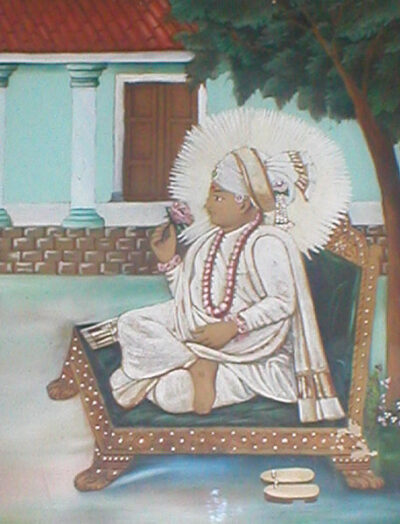
Swaminarayan
Swaminarayan was a Founder and deity of the Swaminarayan sect. Born April 3, 1781, in Chhapaiya. Died June 1, 1830, in Gadhada.
Facts
9 facts · 2 confirmed by two sources · 3 cited · 4 from one source
Where this comes from
Papalocal keeps its own record. It started from these sources; what each one said is kept here as it was copied, so a change on their side never changes this page by itself. Tap one to read its version.
What Wikidata says · copied November 16, 2026 · revision 2556988016
- Described as
- Founder and deity of the Swaminarayan sect
- Other names
- Sahajanand Swami, Neelkanth Varni, Shriji Maharaj, Harikrishna, Narayan muni, Ghanshyam Pandey
- Born
- April 3, 1781 · 1 reference
- Died
- June 1, 1830 · 1 reference
- Born in
- Chhapaiya · 1 reference
- Died in
- Gadhada · 1 reference
- Occupation
- religious leader; yogi · 1 reference; spiritual teacher · 1 reference
- Field
- Hinduism · 1 reference
- Religion
- Hinduism
- Wikipedias with a page
- 35
Wikidata item Q931506 (wikidata.org/wiki/Q931506), public domain (CC0). Copied November 16, 2026.
What Wikipedia says · copied November 16, 2026 · revision 1381737836
Swaminarayan (IAST: Svāmīnārāyaṇa; 3 April 1781 – 1 June 1830), also known as Sahajanand Swami, was a yogi and ascetic believed by followers to be a manifestation of Krishna or the highest manifestation of Purushottama, around whom the Swaminarayan Sampradaya developed.
In 1800, he was initiated into the Uddhava sampradaya by his guru, Swami Ramanand, and was given the name Sahajanand Swami. Despite opposition, in 1802, Ramanand handed over the leadership of the Uddhava Sampradaya to him before his death. According to the Swaminarayan tradition, Sahajanand Swami became known as Swaminarayan, and the Uddhava Sampradaya became known as the Swaminarayan Sampradaya, after a gathering in which he taught the Swaminarayan Mantra to his followers.
He emphasized "moral, personal, and social betterment," and ahimsa. He is also remembered within the sect for undertaking reforms for women and the poor, and performing large-scale non-violent yajñas (fire sacrifices).
During his lifetime, Swaminarayan institutionalized his charisma and beliefs in various ways. He oversaw the construction of six mandirs to facilitate devotional worship of God by his followers, and encouraged the creation of a scriptural tradition, including the Shikshapatri, which he wrote in 1826. In 1826, through a legal document titled the Lekh, Swaminarayan created two dioceses, the Laxmi Narayan Dev Gadi (Vadtal Gadi) and Nar Narayan Dev Gadi (Ahmedabad Gadi), with a hereditary leadership of acharyas and their wives, beginning with two of his nephews whom he formally adopted, who were authorized to install statues of deities in temples and to initiate ascetics.
- Born, in its opening lines
- April 3, 1781
- Died, in its opening lines
- June 1, 1830
From the Wikipedia article “Swaminarayan” (en.wikipedia.org/wiki/Swaminarayan), by its contributors, under CC BY-SA 4.0 (creativecommons.org/licenses/by-sa/4.0/). Copied November 16, 2026; not changed.
Confirmed Two sources agree. Cited One source, and it names where it got it. One source One source, without a reference of its own. Sources disagree The sources disagree. We show the best-supported value and keep theirs below.
