
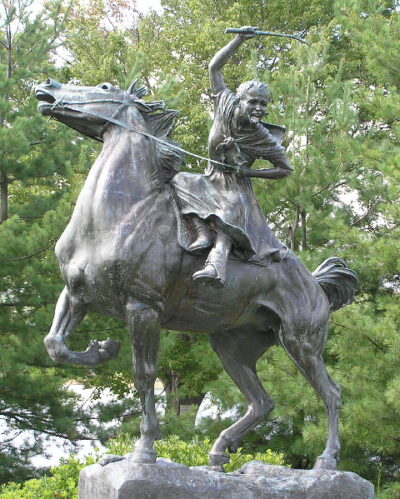
Sybil Ludington
Sybil Ludington was an American revolutionary heroine. Born April 5, 1761, in Dutchess County. Died February 26, 1839, in Unadilla.
Facts
9 facts · 2 confirmed by two sources · 4 cited · 3 from one source
Where this comes from
Papalocal keeps its own record. It started from these sources; what each one said is kept here as it was copied, so a change on their side never changes this page by itself. Tap one to read its version.
What Wikidata says · copied November 18, 2026 · revision 2517028811
- Described as
- American revolutionary heroine (1761-1839)
- Other names
- Sibbell Ludington
- Born
- April 5, 1761 · 4 references
- Died
- February 26, 1839 · 5 references
- Born in
- Dutchess County · 1 reference
- Died in
- Unadilla · 2 references
- Buried in
- Maple Avenue Cemetery · 1 reference
- Citizen of
- United States
- Occupation
- revolutionary
- Father
- Henry Ludington · 1 reference
- Siblings
- Lewis Ludington
- Wikipedias with a page
- 18
Wikidata item Q540504 (wikidata.org/wiki/Q540504), public domain (CC0). Copied November 18, 2026.
What Wikipedia says · copied November 18, 2026 · revision 1383629646
Sybil (or Sibbell) Ludington (April 5, 1761 – February 26, 1839) was an alleged heroine of the American Revolution and daughter of Patriot colonel Henry Ludington. Relatives of Ludington have claimed that on April 26, 1777, at age 16, she made an all-night horseback ride 40 miles (64 km) to stir American militiamen to attack British forces near Danbury, Connecticut, though scholars largely reject this story. According to the legend, Ludington rode near the Connecticut–New York border after British forces raided and burned Danbury, rallying combatants for the Battle of Ridgefield the following day.
Printed accounts of Ludington's ride first appeared in an 1880 local history and then a 1907 posthumous publication by her grandchildren of her father's memoirs, with Ludington often described as a female Paul Revere. A 2015 report in The New England Quarterly concludes there is little actual evidence backing the story, and whether the ride even occurred has been questioned, with skepticism going back at least to 1956.
Relatively unknown through the 19th century, Ludington's story gained recognition around the time of World War II, after New York State was convinced to place historic roadmarkers in locations she was speculated to have visited on her ride. Attention to her story grew thereafter, from memorial statues honoring her, to books being written about her, culminating with being honored on a United States Bicentennial postage stamp that was released on March 25, 1975, which depicts her on a horse.
- Born, in its opening lines
- April 5, 1761
- Died, in its opening lines
- February 26, 1839
From the Wikipedia article “Sybil Ludington” (en.wikipedia.org/wiki/Sybil_Ludington), by its contributors, under CC BY-SA 4.0 (creativecommons.org/licenses/by-sa/4.0/). Copied November 18, 2026; not changed.
Confirmed Two sources agree. Cited One source, and it names where it got it. One source One source, without a reference of its own. Sources disagree The sources disagree. We show the best-supported value and keep theirs below.
