
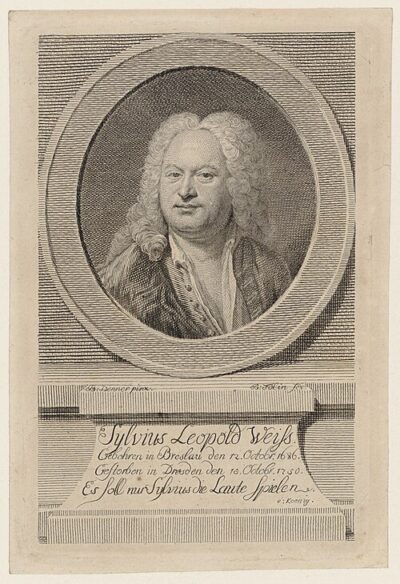
Sylvius Leopold Weiss
Sylvius Leopold Weiss was a German composer and lutenist. Born October 12, 1687, in Grodków. Died October 16, 1750, in Dresden.
Facts
11 facts · 2 confirmed by two sources · 6 cited · 2 from one source · 1 where the sources disagree
What’s different
- Born: we show October 12, 1687 (Confirmed). Wikidata also lists 1686
- Died: we show October 16, 1750 (Confirmed). Wikidata also lists October 18, 1750
- Born in: we show Grodków (Sources disagree). Wikidata also lists Wrocław
Where this comes from
Papalocal keeps its own record. It started from these sources; what each one said is kept here as it was copied, so a change on their side never changes this page by itself. Tap one to read its version.
What Wikidata says · copied November 16, 2026 · revision 2567393935
- Described as
- German composer and lutenist
- Other names
- Silvius Leopold Weiss, Sylvius Leopold Weiß
- Born
- October 12, 1687 · 1 reference; 1686 · 8 references
- Died
- October 16, 1750 · 1 reference; October 18, 1750 · 1 reference
- Born in
- Wrocław; Grodków · 1 reference
- Died in
- Dresden · 2 references
- Buried in
- Alter Katholischer Friedhof
- Citizen of
- Germany · 1 reference
- Occupation
- composer · 1 reference; lutenist · 1 reference
- Instrument
- lute
- Siblings
- Johann Sigismund Weiss · 1 reference; Juliana Margaretha Weiss · 1 reference
- Wikipedias with a page
- 28
Wikidata item Q379571 (wikidata.org/wiki/Q379571), public domain (CC0). Copied November 16, 2026.
What Wikipedia says · copied November 16, 2026 · revision 1380480201
Silvius Leopold Weiss (12 October 1687 – 16 October 1750) was a German composer and lutenist. He was born in Silesia (in present-day Poland) to the lutenist Johann Jacob Weiss, who taught the lute to his children. Weiss was a child prodigy and played for Leopold I, Holy Roman Emperor c. 1694. He was employed by nobility including Charles III Philip of Palatinate-Neuburg and Alexander Sobieski, travelling with them to various courts and cities in Europe.
From 1718, Weiss was a musician at the Dresden court of Augustus the Strong, the Elector of Saxony and King of Poland. He played the lute and the theorbo on many occasions. He was acquainted with Johann Sebastian Bach, who frequently visited Dresden, and on occasion they played music together, reportedly competing in playing fantasias and fugues. Bach's trio in A major for violin and harpsichord BWV 1025 is based on a sonata by Weiss.
At the time of his death, Weiss was the highest-paid instrumentalist at the Dresden court. He left the largest known corpus of music for lute and is recognised as one of the greatest lutenists of all time.
- Born, in its opening lines
- October 12, 1687
- Died, in its opening lines
- October 16, 1750
From the Wikipedia article “Silvius Leopold Weiss” (en.wikipedia.org/wiki/Silvius_Leopold_Weiss), by its contributors, under CC BY-SA 4.0 (creativecommons.org/licenses/by-sa/4.0/). Copied November 16, 2026; not changed.
Confirmed Two sources agree. Cited One source, and it names where it got it. One source One source, without a reference of its own. Sources disagree The sources disagree. We show the best-supported value and keep theirs below.
