
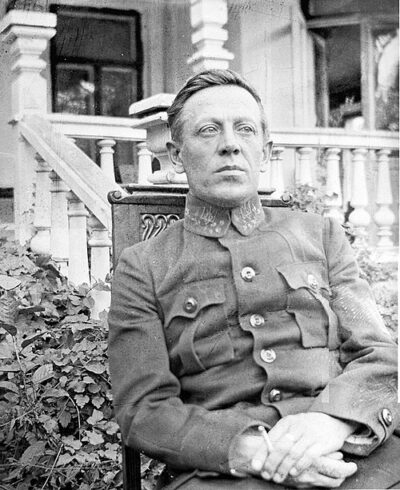
Symon Petliura
Symon Petliura was an Ukrainian military leader. Born May 22, 1879, in Poltava. Died May 25, 1926, in Paris. Positions held include Member of the Russian Constituent Assembly, Minister of Defense of Ukraine and Chairman of the Directorate of Ukraine (1919–1926). Awards include Order of Symon Petliura, Military Cross and Iron Cross.
Facts
25 facts · 2 confirmed by two sources · 8 cited · 15 from one source
Where this comes from
Papalocal keeps its own record. It started from these sources; what each one said is kept here as it was copied, so a change on their side never changes this page by itself. Tap one to read its version.
What Wikidata says · copied November 16, 2026 · revision 2565534203
- Described as
- Ukrainian military leader (1879–1926)
- Other names
- V. Marchenko, V. Salevsky, I. Rokytny, S. Prosvitianyn, O. Riast, Symon Vasylyovych Petliura, Simón Vasílievich Petliura, Symon Vasyliovych Petliura
- Born
- May 22, 1879 · 1 reference
- Died
- May 25, 1926 · 4 references
- Born in
- Poltava · 2 references
- Died in
- Paris · 2 references
- Buried in
- Montparnasse Cemetery
- Citizen of
- Russian Empire; Ukrainian People's Republic
- Occupation
- politician · 1 reference; theatre critic; journalist · 1 reference; writer · 1 reference; opinion journalist · 1 reference
- Positions held
- Member of the Russian Constituent Assembly; Minister of Defense of Ukraine; Chairman of the Directorate of Ukraine (1919–1926); president · 1 reference
- Political party
- Revolutionary Ukrainian Party (1900–1905); Ukrainian Social Democratic Labour Party (1905–1919)
- Awards
- Order of Symon Petliura; Military Cross; Iron Cross
- Spouse
- Olha Petliura (1910–1926)
- Children
- Lesia Petliura · 1 reference
- Religion
- Eastern Orthodoxy
- Military rank
- ataman
- Wikipedias with a page
- 64
Wikidata item Q212676 (wikidata.org/wiki/Q212676), public domain (CC0). Copied November 16, 2026.
What Wikipedia says · copied November 16, 2026 · revision 1384391856
Symon Vasyliovych Petliura (Ukrainian: Симон Васильович Петлюра, Ukrainian pronunciation: [ˈsɪmon ʋɐˈsɪlʲowɪt͡ʃ petˈlʲurɐ]; 22 May [O.S. 10 May] 1879 – 25 May 1926) was a Ukrainian revolutionary, politician and journalist. He was the Supreme Commander of the Ukrainian People's Army (UNA) and led the Ukrainian People's Republic during the Ukrainian War of Independence, a part of the wider Russian Civil War.
Petliura was born to a family of Cossack heritage in Poltava. From an early age he embraced socialism and Ukrainian nationalism, which he advocated through his highly prolific career as a journalist. After the 1917 February Revolution overthrew the Tsarist monarchy, the Ukrainian People's Republic was proclaimed and Petliura was elected head of its military. The Republic was briefly interrupted by the pro-German Ukrainian State, but in late 1918 Petliura, along with other members of the socialist Directorate of Ukraine, organised a revolt and overthrew the regime, restoring the Republic. He became the leader of the Directorate in early 1919, after the Bolsheviks invaded Ukraine and captured its capital. Facing imminent defeat, Petliura entered an alliance with Józef Piłsudski's Poland. The Polish–Soviet War concluded with Poland remaining independent and gaining some Ukrainian and Belarusian lands, while most of Ukraine remained under Soviet control, forcing Petliura into exile. He initially directed the government-in-exile from Poland, but eventually settled in Paris.
During the Civil War, the UNA were responsible for the deaths of tens of thousands of Jewish civilians, and Petliura's role in the pogroms has been a topic of dispute. In 1926, Petliura was assassinated in Paris by Jewish anarchist Sholem Schwarzbard, who had lost relatives in the pogroms.
- Born, in its opening lines
- May 22, 1879
- Died, in its opening lines
- May 25, 1926
From the Wikipedia article “Symon Petliura” (en.wikipedia.org/wiki/Symon_Petliura), by its contributors, under CC BY-SA 4.0 (creativecommons.org/licenses/by-sa/4.0/). Copied November 16, 2026; not changed.
Confirmed Two sources agree. Cited One source, and it names where it got it. One source One source, without a reference of its own. Sources disagree The sources disagree. We show the best-supported value and keep theirs below.
