
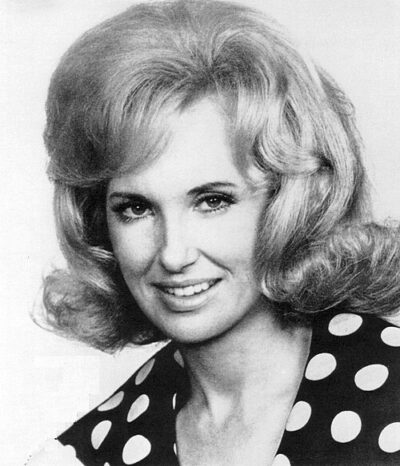
Tammy Wynette
Tammy Wynette was an American country singer. Born May 5, 1942, in Itawamba County. Died April 6, 1998, in Nashville. Awards include Country Music Association Award for Female Vocalist of the Year (3 times) and Grammy Award for Best Female Country Vocal Performance.
Facts
25 facts · 2 confirmed by two sources · 8 cited · 15 from one source
Where this comes from
Papalocal keeps its own record. It started from these sources; what each one said is kept here as it was copied, so a change on their side never changes this page by itself. Tap one to read its version.
What Wikidata says · copied November 15, 2026 · revision 2569415569
- Described as
- American country singer (1942–1998)
- Other names
- Virginia Wynette Richey, Virginia Wynette Pugh
- Born
- May 5, 1942 · 9 references
- Died
- April 6, 1998 · 9 references
- Born in
- Itawamba County
- Died in
- Nashville · 2 references
- Buried in
- Woodlawn Memorial Park Cemetery · 1 reference
- Cause of death
- myocardial infarction
- Name at birth
- Virginia Wynette Pugh · 2 references
- Citizen of
- United States
- Occupation
- singer · 1 reference; singer-songwriter; actor · 1 reference; recording artist; musician · 1 reference; country musician · 1 reference
- Member of
- George Jones & Tammy Wynette
- Genre
- country music; folk music
- Instrument
- voice
- Record label
- Epic Records
- Awards
- Country Music Association Award for Female Vocalist of the Year (3 times) (1968, 1969, 1970); Grammy Award for Best Female Country Vocal Performance · 1 reference
- Spouse
- George Jones (1969–1975) · 1 reference; George Richey · 1 reference
- Children
- Georgette Jones
- Website
- http://www.tammywynette.com/
- Wikipedias with a page
- 39
Wikidata item Q234017 (wikidata.org/wiki/Q234017), public domain (CC0). Copied November 15, 2026.
What Wikipedia says · copied November 15, 2026 · revision 1383200395
Tammy Wynette (born Virginia Wynette Pugh; May 5, 1942 – April 6, 1998) was an American country music singer and songwriter, considered among the genre's most influential and successful artists. Wynette was one of the few singers who brought a woman's perspective to the male-dominated country music field. Her characteristic vocal delivery has been acclaimed by critics, journalists and writers for conveying unique emotion. Twenty of her singles topped the US country chart during her career. Her signature song "Stand by Your Man" received both acclaim and criticism for its portrayal of women's loyalty to their husbands.
Wynette was born and raised near Tremont, a small town in Itawamba County, Mississippi, by her mother, stepfather, and maternal grandparents. During childhood, Wynette picked cotton on her family's farm but also had aspirations of becoming a singer. She performed music through her teen years and married Euple Byrd at age 17. Wynette enrolled in cosmetology school and later appeared on a local country music television program. Wynette then divorced and moved to Nashville, Tennessee, to pursue a country music career in 1965. She soon met her second husband, Don Chapel, and eventually signed with Epic Records. Under the production of Billy Sherrill, her first single, "Apartment No. 9", was released in 1966. In 1967, she had her first commercial success with the single "Your Good Girl's Gonna Go Bad". In the late 1960s, Wynette's career rose further with the number one country singles "I Don't Wanna Play House", "D-I-V-O-R-C-E" and the self-penned "Stand by Your Man".
As her career entered the 1970s, Wynette was among country music's most popular artists and regularly topped the charts. During the late 1960s, she had met and in 1969 married her third husband, fellow country artist George Jones. The pair had a recording career together that resulted in several number one country singles and a successful touring act. However, their relationship was tumultuous and they divorced in 1975. Following their separation Wynette returned as a headlining solo performer. She also continued to have singles regularly make the upper reaches of the country charts into the 1980s. During this time, she also acted on several television shows, including Capitol (1986). Wynette had several more high-profile relationships before marrying her final husband, George Richey, in 1978. Several intestinal health problems led to hospitalizations and addictions to prescription pain killers, the latter of which was said to have led to her death in 1998.
Wynette has sold an estimated 30 million records worldwide. She has received two Grammy Awards, three Country Music Association awards, and two Academy of Country Music Awards. Wynette was also among country music's first female performers to have discs certify gold and platinum by the Recording Industry Association of America. Her influence as a country music artist led to several inductions into music associations. This includes inductions into the Country Music Hall of Fame and the Nashville Songwriters Hall of Fame.
- Born, in its opening lines
- May 5, 1942
- Died, in its opening lines
- April 6, 1998
From the Wikipedia article “Tammy Wynette” (en.wikipedia.org/wiki/Tammy_Wynette), by its contributors, under CC BY-SA 4.0 (creativecommons.org/licenses/by-sa/4.0/). Copied November 15, 2026; not changed.
Confirmed Two sources agree. Cited One source, and it names where it got it. One source One source, without a reference of its own. Sources disagree The sources disagree. We show the best-supported value and keep theirs below.
