
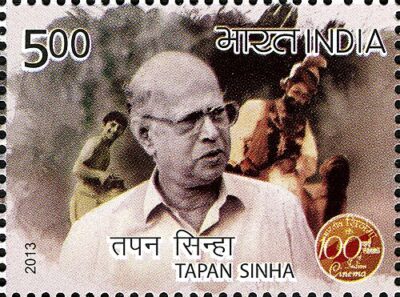
Tapan Sinha
Tapan Sinha was an Indian film director. Born October 2, 1924, in Kolkata. Died January 15, 2009, in Kolkata. Educated at University of Calcutta and Patna University. Awards include Dadasaheb Phalke Award and Padma Shri in Art.
Facts
23 facts · 2 confirmed by two sources · 7 cited · 14 from one source
What’s different
- Born: we show October 2, 1924 (Confirmed). Wikidata also lists October 22, 1924
Where this comes from
Papalocal keeps its own record. It started from these sources; what each one said is kept here as it was copied, so a change on their side never changes this page by itself. Tap one to read its version.
What Wikidata says · copied November 18, 2026 · revision 2566874720
- Described as
- Indian film director (1924–2009)
- Born
- October 2, 1924; October 22, 1924 · 1 reference
- Died
- January 15, 2009 · 2 references
- Born in
- Kolkata · 1 reference
- Died in
- Kolkata · 1 reference
- Cause of death
- bronchopneumonia
- Citizen of
- British Raj (–1947); India (1950–); Dominion of India (1947–1950)
- Occupation
- author · 1 reference; film director · 1 reference; screenwriter; composer; lyricist; film producer · 1 reference; director · 1 reference; songwriter · 1 reference
- Education
- University of Calcutta; Patna University; University College of Science, Technology & Agriculture
- Awards
- Dadasaheb Phalke Award (2007); Padma Shri in Art
- Spouse
- Arundhati Devi
- Children
- Anindya Sinha · 1 reference
- Wikipedias with a page
- 20
Wikidata item Q940858 (wikidata.org/wiki/Q940858), public domain (CC0). Copied November 18, 2026.
What Wikipedia says · copied November 18, 2026 · revision 1384702056
Tapan Sinha (2 October 1924 – 15 January 2009) was one of the most prominent Indian film directors of his time, forming a legendary quartet with Satyajit Ray, Ritwik Ghatak and Mrinal Sen. Primarily a Bengali filmmaker, he worked in both Hindi cinema and Bengali cinema, directing films like Kabuliwala (1957), Louha-Kapat, Sagina Mahato (1970), Apanjan (1968), Kshudhita Pashan and children's film Safed Haathi (1978) and Aaj Ka Robinhood. Sinha started his career in 1946, as a sound engineer with New Theatres film production house in Kolkata, then in 1950 left for England where he worked at Pinewood Studios for the next two years, before returning home to start his six decade long career in Indian cinema, making films in Bengali, Hindi and Oriya languages, straddling genres from social realism, family drama, labor rights, to children's fantasy films. He was an acclaimed filmmaker of the parallel cinema movement of India.
- Born, in its opening lines
- October 2, 1924
- Died, in its opening lines
- January 15, 2009
From the Wikipedia article “Tapan Sinha” (en.wikipedia.org/wiki/Tapan_Sinha), by its contributors, under CC BY-SA 4.0 (creativecommons.org/licenses/by-sa/4.0/). Copied November 18, 2026; not changed.
Confirmed Two sources agree. Cited One source, and it names where it got it. One source One source, without a reference of its own. Sources disagree The sources disagree. We show the best-supported value and keep theirs below.
