
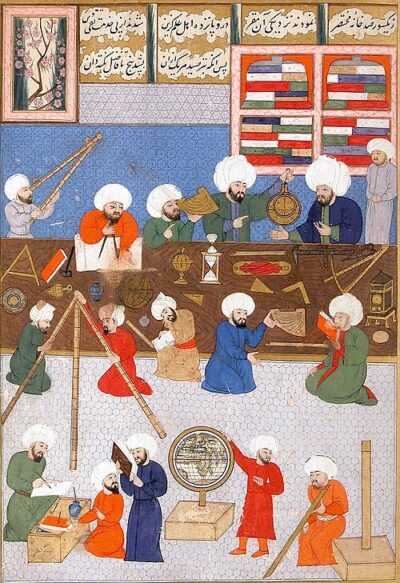
Taqi al-Din Muhammad ibn Ma'ruf
Taqi al-Din Muhammad ibn Ma'ruf was an Ottoman Syrian polymath. Born June 14, 1526, in Damascus. Died 1585, in Istanbul. Known for globe at the Istanbul Observatory.
Facts
17 facts · 2 confirmed by two sources · 6 cited · 9 from one source
What’s different
- Born: we show June 14, 1526 (Confirmed). Wikidata also lists 1525
- Died: we show 1585 (Confirmed). Wikidata also lists 1580s
Where this comes from
Papalocal keeps its own record. It started from these sources; what each one said is kept here as it was copied, so a change on their side never changes this page by itself. Tap one to read its version.
What Wikidata says · copied November 16, 2026 · revision 2555295648
- Described as
- Ottoman Syrian polymath (1526-1585)
- Born
- June 14, 1526 · 2 references; 1525 · 1 reference
- Died
- 1580s · 3 references; 1585 · 2 references
- Born in
- Damascus · 1 reference
- Died in
- Istanbul
- Citizen of
- Syria; Ottoman Empire
- Occupation
- mathematician · 1 reference; astronomer · 3 references; inventor · 1 reference; pharmacist; astrologer; engineer; university teacher · 1 reference; polymath · 1 reference
- Known for
- globe at the Istanbul Observatory
- Field
- Nadin
- Religion
- Islam
- Wikipedias with a page
- 31
Wikidata item Q1379164 (wikidata.org/wiki/Q1379164), public domain (CC0). Copied November 16, 2026.
What Wikipedia says · copied November 16, 2026 · revision 1375225670
Taqi ad-Din Muhammad ibn Ma'ruf ash-Shami al-Asadi (Arabic: تقي الدين محمد بن معروف الشامي; Ottoman Turkish: تقي الدين محمد بن معروف الشامي السعدي; Turkish: Takiyüddin 1526–1585) was an Ottoman polymath active in Cairo and Constantinople. He was the author of more than ninety books on a wide variety of subjects, including astronomy, clocks, engineering, mathematics, mechanics, optics, and natural philosophy.
In 1574 the Ottoman Sultan Murad III invited Taqi ad-Din to build an observatory in the Ottoman capital, Constantinople. Taqi ad-Din constructed instruments such as an armillary sphere and mechanical clocks that he used to observe the Great Comet of 1577. He also used European celestial and terrestrial globes that were delivered to Constantinople in gift exchanges.
His major work from the use of his observatory is titled "The tree of ultimate knowledge [in the end of time or the world] in the Kingdom of the Revolving Spheres: The astronomical tables of the King of Kings [Murad III]" (Sidrat al-muntah al-afkar fi malkūt al-falak al-dawār– al-zij al-Shāhinshāhi). The work was prepared according to the results of the observations carried out in Egypt and Constantinople in order to correct and complete Ulugh Beg's 15th century work, the Zij-i Sultani. The first 40 pages of the work dealt with calculations, followed by discussions of astronomical clocks, heavenly circles, and information on three eclipses which he observed in Cairo and Istanbul.
As a polymath, Taqi al-Din wrote numerous books on astronomy, mathematics, mechanics, and theology. His method of finding coordinates of stars were reportedly so precise that he got better measurements than his contemporaries, Tycho Brahe and Nicolas Copernicus. Brahe is also thought to have been aware of Taqi al-Din's work.
Taqi ad-Din also described a steam turbine with the practical application of rotating a spit in 1551. He worked on and created astronomical clocks for his observatory. Taqi ad-Din also wrote a book on optics, in which he determined the light emitted from objects, proved the Law of Reflection observationally, and worked on refraction.
- Born, in its opening lines
- 1526
- Died, in its opening lines
- 1585
From the Wikipedia article “Taqi ad-Din Muhammad ibn Ma'ruf” (en.wikipedia.org/wiki/Taqi_ad-Din_Muhammad_ibn_Ma'ruf), by its contributors, under CC BY-SA 4.0 (creativecommons.org/licenses/by-sa/4.0/). Copied November 16, 2026; not changed.
Confirmed Two sources agree. Cited One source, and it names where it got it. One source One source, without a reference of its own. Sources disagree The sources disagree. We show the best-supported value and keep theirs below.
