
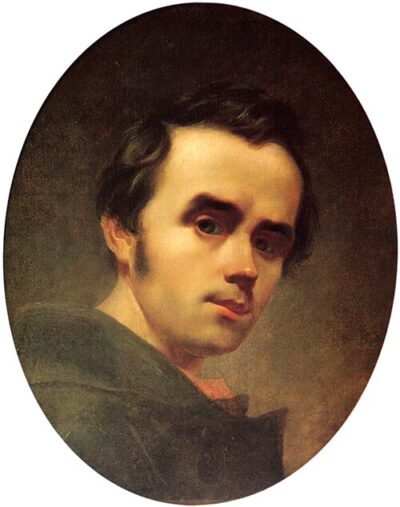
Taras Shevchenko
Taras Shevchenko was an Ukrainian poet and artist. Born February 25, 1814, in Moryntsi. Died February 26, 1861, in Saint Petersburg. Known for Kobzar, Haydamaky and Dream. Educated at Imperial Academy of Arts.
Facts
29 facts · 0 confirmed by two sources · 9 cited · 18 from one source · 2 where the sources disagree
What’s different
- Born: we show February 25, 1814 (Sources disagree). Wikipedia says March 9, 1814
- Died: we show February 26, 1861 (Sources disagree). Wikipedia says March 10, 1861
Where this comes from
Papalocal keeps its own record. It started from these sources; what each one said is kept here as it was copied, so a change on their side never changes this page by itself. Tap one to read its version.
What Wikidata says · copied November 16, 2026 · revision 2566311747
- Described as
- Ukrainian poet and artist (1814–1861)
- Other names
- Kobzar Darmohrai, Grigor'yevich Shevchenko, T. Shevchenko, Perebendya, Taras Grigor'yevich Shevchenko, Taras. Shevchenko, K.Darmohrai, Taras Ševčenko, Taras Hryhorovyč Ševčenko, Taras Hryhorovych Shevchenko, Taras Grigorjevič Ševčenko, Tarass Grigorjewitsch Schewtschenko
- Born
- February 25, 1814 · 4 references
- Died
- February 26, 1861 · 2 references
- Born in
- Moryntsi · 4 references
- Died in
- Saint Petersburg · 3 references
- Buried in
- Taras Hill (1861–)
- Cause of death
- ascites · 1 reference
- Name at birth
- Тарас Григорович Шевченко · 1 reference
- Citizen of
- Russian Empire · 3 references
- Occupation
- painter · 2 references; poet · 5 references; anthropologist; artist · 2 references; writer · 3 references; playwright; ethnographer; prose writer · 1 reference
- Worked for
- Imperial University of St. Vladimir
- Education
- Imperial Academy of Arts (1838–1844)
- Known for
- Kobzar; Haydamaky; Dream
- Father
- Hryhoriy Ivanovych Shevchenko
- Mother
- Kateryna Y. Boiko
- Siblings
- Yosyp H. Shevchenko; Mykyta G. Shevchenko; Yaryna Boiko; Kateryna H. Krasytska
- Religion
- Eastern Orthodox Church
- Military rank
- Private · 1 reference
- Wikipedias with a page
- 138
Wikidata item Q134958 (wikidata.org/wiki/Q134958), public domain (CC0). Copied November 16, 2026.
What Wikipedia says · copied November 16, 2026 · revision 1385314122
Taras Hryhorovych Shevchenko (Ukrainian: Тарас Григорович Шевченко, Ukrainian pronunciation: [tɐˈrɑz‿ɦrɪˈɦɔrowɪt͡ʃ ʃeu̯ˈt͡ʃɛnko]; Russian: Тарас Григорьевич Шевченко, romanized: Taras Grigoryevich Shevchenko; 9 March 1814 – 10 March 1861) was a Ukrainian poet, writer, artist, public and political figure, folklorist and ethnographer. His literary heritage, in particular the poetry collection Kobzar, is regarded to be the foundation of modern Ukrainian literature and to some degree also of the modern Ukrainian language. The significance of Shevchenko's creative genius for the Ukrainian and wider Slavic culture has led some to compare his figure to that of Robert Burns.
Shevchenko was born into a poor family of serfs during the period of Russian rule over Ukraine. In his youth, he demonstrated a talent for art and became a fellow of the Imperial Academy of Arts in Saint Petersburg. After his return to Ukraine, he joined the emerging national movement. Exiled to Central Asia due to his association with the Brotherhood of Saints Cyril and Methodius, Shevchenko continued to create art and poetry despite prohibitions, and his figure attained fame among the liberal-minded circles of the Russian Empire. He wrote poetry in Ukrainian and prose (nine novellas, a diary and his autobiography) in Russian. Freed from exile after the onset of liberal reforms of Alexander II, he was barred from settling in Ukraine and died in Saint Petersburg.
- Born, in its opening lines
- March 9, 1814
- Died, in its opening lines
- March 10, 1861
From the Wikipedia article “Taras Shevchenko” (en.wikipedia.org/wiki/Taras_Shevchenko), by its contributors, under CC BY-SA 4.0 (creativecommons.org/licenses/by-sa/4.0/). Copied November 16, 2026; not changed.
Confirmed Two sources agree. Cited One source, and it names where it got it. One source One source, without a reference of its own. Sources disagree The sources disagree. We show the best-supported value and keep theirs below.
