
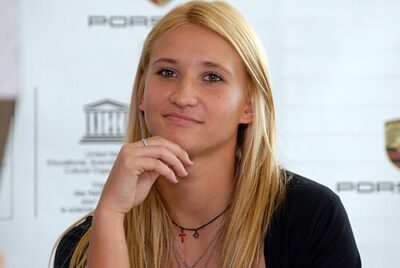
Tatiana Golovin
Tatiana Golovin is a French tennis player. Born January 25, 1988, in Moscow. Teams include Französische Billie-Jean-King-Cup-Mannschaft.
Facts
11 facts · 1 confirmed by two sources · 3 cited · 7 from one source
Where this comes from
Papalocal keeps its own record. It started from these sources; what each one said is kept here as it was copied, so a change on their side never changes this page by itself. Tap one to read its version.
What Wikidata says · copied November 16, 2026 · revision 2520146101
- Described as
- French tennis player
- Born
- January 25, 1988 · 1 reference
- Born in
- Moscow · 1 reference
- Citizen of
- Russia; France (1992–) · 1 reference
- Occupation
- tennis player (2002–2008); color commentator
- Teams
- Französische Billie-Jean-King-Cup-Mannschaft
- Sport
- tennis · 1 reference
- Spouse
- Hugo Bonneval (2014–) · 1 reference
- Lived in
- Miami
- Height
- 1.75 m (5 ft 9 in)
- Wikipedias with a page
- 30
Wikidata item Q233256 (wikidata.org/wiki/Q233256), public domain (CC0). Copied November 16, 2026.
What Wikipedia says · copied November 16, 2026 · revision 1383882207
Tatiana Golovin (Russian: Татья́на Григóрьевна Головина́, romanized: Tatyana Grigoryevna Golovina; born 25 January 1988) is a French former professional tennis player. She won the 2004 French Open mixed-doubles event, partnering with Richard Gasquet, and reached the singles quarterfinals at the 2006 US Open, losing to the eventual champion Maria Sharapova. Her career-high singles ranking is world No. 12. In 2008, she was diagnosed with lower back inflammation and was forced to stop playing competitive tennis.
- Born, in its opening lines
- January 25, 1988
From the Wikipedia article “Tatiana Golovin” (en.wikipedia.org/wiki/Tatiana_Golovin), by its contributors, under CC BY-SA 4.0 (creativecommons.org/licenses/by-sa/4.0/). Copied November 16, 2026; not changed.
Confirmed Two sources agree. Cited One source, and it names where it got it. One source One source, without a reference of its own. Sources disagree The sources disagree. We show the best-supported value and keep theirs below.
