
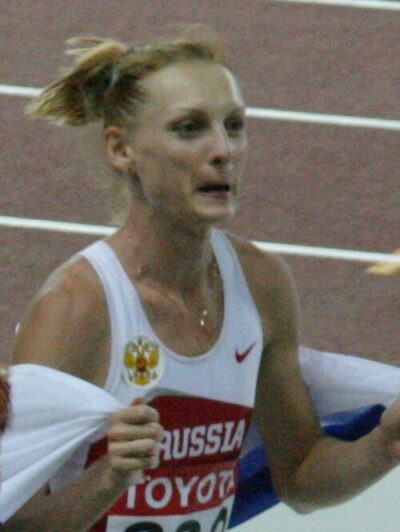
Tatyana Kotova is a Russian athlete. Born December 11, 1976, in Qoʻqon.
Facts
7 facts · 1 confirmed by two sources · 0 cited · 6 from one source
Where this comes from
Papalocal keeps its own record. It started from these sources; what each one said is kept here as it was copied, so a change on their side never changes this page by itself. Tap one to read its version.
What Wikidata says · copied November 17, 2026 · revision 2560062490
- Described as
- Russian athlete
- Other names
- Tatyana Vladimirovna Kotova
- Born
- December 11, 1976 · 1 reference
- Born in
- Qoʻqon
- Citizen of
- Soviet Union; Russia
- Occupation
- long jumper
- Sport
- athletics
- Height
- 1.82 m (6 ft 0 in)
- Wikipedias with a page
- 27
Wikidata item Q236306 (wikidata.org/wiki/Q236306), public domain (CC0). Copied November 17, 2026.
What Wikipedia says · copied November 17, 2026 · revision 1361776459
Tatyana Vladimirovna Kotova (Russian: Татьяна Владимировна Котова, born 11 December 1976) is a track and field athlete who competed for Russia in the long jump. Her personal best jump of 7.42 m at Annecy in 2002, is the best distance achieved by a female long jumper in the 21st century (as of 2026).
Kotova won bronze medals in the event at the 2000 and 2004 Olympic Games. She won three consecutive silver medals at the World Championships in Athletics from 2001 to 2005, also taking bronze in 2007. She had even greater success indoors, where she won the World Indoor Championships on three occasions, in 1999, 2003 and 2006, as well as finishing as runner-up in 2001 and 2004. She was later stripped of her 2005 World silver and 2006 World Indoor title. Her other titles include wins at the 2002 European Championships and the 2002 IAAF World Cup. She was third at the 2001 Goodwill Games and was the jackpot winner of the 2000 IAAF Golden League.
- Born, in its opening lines
- December 11, 1976
From the Wikipedia article “Tatyana Kotova” (en.wikipedia.org/wiki/Tatyana_Kotova), by its contributors, under CC BY-SA 4.0 (creativecommons.org/licenses/by-sa/4.0/). Copied November 17, 2026; not changed.
Confirmed Two sources agree. Cited One source, and it names where it got it. One source One source, without a reference of its own. Sources disagree The sources disagree. We show the best-supported value and keep theirs below.
