
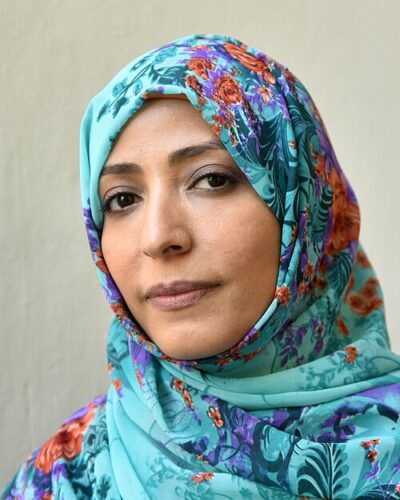
Tawakkol Karman
Tawakkol Karman is a Yemeni-Turkish journalist, politician and human rights activist. Born February 7, 1979, in Ta'izz. Educated at Sanaa University and University of Alberta. Awards include Nobel Peace Prize.
Facts
19 facts · 1 confirmed by two sources · 9 cited · 9 from one source
Where this comes from
Papalocal keeps its own record. It started from these sources; what each one said is kept here as it was copied, so a change on their side never changes this page by itself. Tap one to read its version.
What Wikidata says · copied November 16, 2026 · revision 2563063783
- Described as
- Yemeni-Turkish journalist, politician and human rights activist (born 1979)
- Other names
- Tawakkol Abdel-Salam Khalid Karman, Tawakel Karman, Tawakkul Karmān, Tawakul Karman
- Born
- February 7, 1979 · 5 references
- Born in
- Ta'izz · 1 reference
- Citizen of
- Yemen · 3 references
- Occupation
- peace activist; journalist · 2 references; politician · 1 reference; human rights defender · 1 reference; civil rights advocate · 1 reference
- Education
- Sanaa University; University of Alberta · 1 reference; University of Massachusetts Lowell
- Member of
- Nobel Women's Initiative · 1 reference
- Awards
- Nobel Peace Prize (2011) · 2 references
- Field
- human rights
- Father
- Abdulslam Karman
- Siblings
- Safa Karman
- Religion
- Islam · 1 reference
- Website
- http://www.tawakkolkarman.net; https://tkif.org/en/
- Wikipedias with a page
- 95
Wikidata item Q104622 (wikidata.org/wiki/Q104622), public domain (CC0). Copied November 16, 2026.
What Wikipedia says · copied November 16, 2026 · revision 1384028057
Tawakkol Abdel-Salam Khalid Karman (Arabic: توكل عبد السلام خالد كرمان, romanized: Tawakkul 'Abd us-Salām Khālid Karmān; Turkish: Tevekkül Karman; born 7 February 1979) is a Yemeni journalist, politician, and human rights activist. She co-founded and leads 'Women Journalists Without Chains', a group established in 2005 to advocate for press freedom and human rights. She became the international public face of the 2011 Yemeni uprising that was part of the Arab Spring movement. She was often referred as the 'Iron Woman' and the 'Mother of the Revolution" in Yemen. She is a co-recipient of the 2011 Nobel Peace Prize for "non-violent struggle for the safety of women and for women's rights to full participation in peace-building work". She became the first Yemeni, the first Arab woman, and the second Muslim woman to win a Nobel Prize.
Karman gained prominence in Yemen after 2005 as a Yemeni journalist and an advocate for press freedom, particularly following the denial of a license for a mobile phone news service in 2007, after which she led protests. After May 2007, she organized weekly protests advocating for broader reforms in Yemen. In early 2011, she shifted the protests to align with the broader Arab Spring movement, inspired by the Tunisian revolution that overthrew the government of Zine El Abidine Ben Ali. She was a vocal opponent who called for the end of President Ali Abdullah Saleh's government.
- Born, in its opening lines
- February 7, 1979
From the Wikipedia article “Tawakkol Karman” (en.wikipedia.org/wiki/Tawakkol_Karman), by its contributors, under CC BY-SA 4.0 (creativecommons.org/licenses/by-sa/4.0/). Copied November 16, 2026; not changed.
Confirmed Two sources agree. Cited One source, and it names where it got it. One source One source, without a reference of its own. Sources disagree The sources disagree. We show the best-supported value and keep theirs below.
