
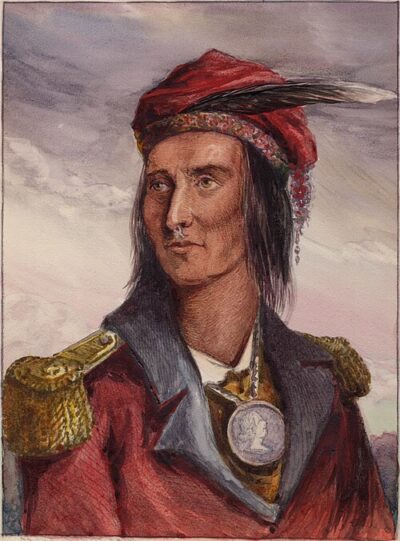
Tecumseh
Tecumseh was a Shawnee Native American military leader. Born 1768, in Chillicothe. Died October 5, 1813, in Moravian Indian Reserve 47. Awards include Person of National Historic Significance.
Facts
10 facts · 2 confirmed by two sources · 3 cited · 5 from one source
Where this comes from
Papalocal keeps its own record. It started from these sources; what each one said is kept here as it was copied, so a change on their side never changes this page by itself. Tap one to read its version.
What Wikidata says · copied November 16, 2026 · revision 2568061195
- Described as
- Shawnee Native American military leader (1768-1813)
- Other names
- Shooting Star
- Born
- 1768 · 1 reference
- Died
- October 5, 1813 · 6 references
- Born in
- Chillicothe
- Died in
- Moravian Indian Reserve 47
- Cause of death
- death in battle · 1 reference
- Citizen of
- Shawnee
- Occupation
- traditional leader or chief · 1 reference
- Awards
- Person of National Historic Significance · 1 reference
- Siblings
- Ontario
- Military rank
- war chief
- Wikipedias with a page
- 50
Wikidata item Q257808 (wikidata.org/wiki/Q257808), public domain (CC0). Copied November 16, 2026.
What Wikipedia says · copied November 16, 2026 · revision 1383448740
Tecumseh ( tih-KUM-sə, -see; March 9, 1768 – October 5, 1813) was a Shawnee chief and warrior who promoted resistance to the expansion of the United States onto Native American lands. A persuasive orator, Tecumseh traveled widely, forming a Native American confederacy and promoting intertribal unity. Even though his efforts to unite Native Americans ended with his death in battle during the War of 1812, he became a folk hero in American, Indigenous, and Canadian popular history.
Tecumseh was born in what is now Ohio at a time when the far-flung Shawnees were reuniting in their Ohio Country homeland. During his childhood, the Shawnees lost territory to the expanding American colonies in a series of border conflicts. Tecumseh's father was killed in the 1774 Battle of Point Pleasant. Tecumseh was thereafter taught by his older brother Cheeseekau, a noted war chief who died fighting Americans in 1792. As a young war leader, Tecumseh joined Shawnee Chief Blue Jacket's armed struggle against further American encroachment, which ended in defeat at the Battle of Fallen Timbers in 1794 and with the loss of most of Ohio in the 1795 Treaty of Greenville.
In 1805, Tecumseh's younger brother Tenskwatawa founded a religious movement that called upon Native Americans to reject European influences and return to a more traditional lifestyle. In 1808, Tecumseh and Tenskwatawa established Prophetstown, a village in present-day Indiana, that grew into a large, multi-tribal community. Tecumseh proclaimed that Native Americans owned their lands in common and urged tribes not to cede more territory unless all agreed. His message alarmed American leaders as well as Native leaders who sought accommodation with the United States. In 1811, when Tecumseh was in the South recruiting allies, Americans under William Henry Harrison defeated Tenskwatawa at the Battle of Tippecanoe and destroyed Prophetstown.In the War of 1812, Tecumseh joined his cause with the British, recruited warriors, and helped capture Detroit in August 1812. The following year he led an unsuccessful campaign against the United States in Ohio and Indiana. When U.S. naval forces took control of Lake Erie in 1813, Tecumseh reluctantly retreated with the British into Upper Canada. There, American troops led by Richard Mentor Johnson engaged them at the Battle of the Thames on October 5, 1813, during which Tecumseh was killed. His death caused his multi-tribal confederacy to collapse. The lands he had fought to defend were eventually ceded to the U.S. government. His legacy as one of the most celebrated Native Americans in history grew after his death, although details of his life have often been obscured by mythology.
- Born, in its opening lines
- March 9, 1768
- Died, in its opening lines
- October 5, 1813
From the Wikipedia article “Tecumseh” (en.wikipedia.org/wiki/Tecumseh), by its contributors, under CC BY-SA 4.0 (creativecommons.org/licenses/by-sa/4.0/). Copied November 16, 2026; not changed.
Confirmed Two sources agree. Cited One source, and it names where it got it. One source One source, without a reference of its own. Sources disagree The sources disagree. We show the best-supported value and keep theirs below.
