
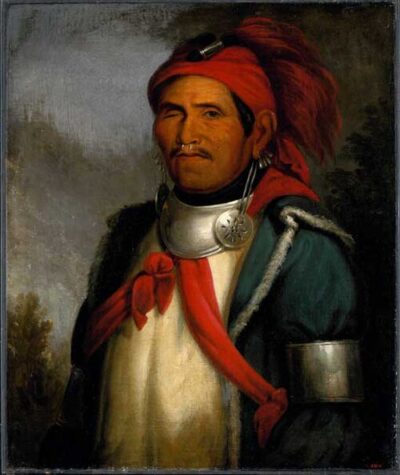
Tenskwatawa
Tenskwatawa was a Shawnee Native American leader, brother of Tecumseh. Born January 1775, in Ohio. Died November 1836, in Kansas.
Facts
8 facts · 2 confirmed by two sources · 1 cited · 5 from one source
Where this comes from
Papalocal keeps its own record. It started from these sources; what each one said is kept here as it was copied, so a change on their side never changes this page by itself. Tap one to read its version.
What Wikidata says · copied November 16, 2026 · revision 2565573481
- Described as
- Shawnee Native American leader, brother of Tecumseh (1775–1836)
- Other names
- Tenskatawa, Tenskwatawah, Tensquatawa, Lalawethika, the Prophet, the Shawnee Prophet, Ellskwatawa
- Born
- January 1775 · 3 references
- Died
- November 1836 · 2 references
- Born in
- Ohio
- Died in
- Kansas
- Buried in
- Kansas
- Citizen of
- United States
- Occupation
- traditional leader or chief
- Siblings
- Tecumseh · 1 reference
- Wikipedias with a page
- 22
Wikidata item Q254682 (wikidata.org/wiki/Q254682), public domain (CC0). Copied November 16, 2026.
What Wikipedia says · copied November 16, 2026 · revision 1376186528
Tenskwatawa (; also called Tenskatawa, Tenskwatawah, Tensquatawa or Lalawethika) (January 1775 – November 1836) was a Native American religious and political leader of the Shawnee people, known as the Prophet or the Shawnee Prophet. He was a younger brother of Tecumseh, a leader of the Shawnee. In his early years Tenskwatawa was given the name Lalawethika ("He Makes a Loud Noise" or "The Noise Maker"), but he changed it around 1805 and transformed himself from a hapless, alcoholic youth into a spiritual leader.
In the early 1800s, Tenskwatawa formed a community with his followers near Greenville in western Ohio, and in 1808 he and Tecumseh established a village that the Americans called Prophetstown north of present-day Lafayette, Indiana. At Prophetstown, the brothers' Pan-American Indian resistance movement increased to include thousands of followers, and Tenskwatawa provided the spiritual foundation. Together, they mobilized the Indigenous American Nations in the Northwest Territory to fight settlers.On November 7, 1811, while Tecumseh was away, Tenskwatawa ordered the pre-dawn attack on a hostile, encroaching military force encamped near Prophetstown that initiated the Battle of Tippecanoe. The American Indians retreated after a two-hour engagement and abandoned Prophetstown, which the Americans burned to the ground. The battle did not end the American Indians' resistance against the United States, but he lost his influence, became an outcast, and moved to Canada during the War of 1812. After Tecumseh was killed at the Battle of the Thames in 1813, the American Indian resistance movement faltered and was eventually defeated. Tenskwatawa remained as an exile in Canada for nearly a decade. He returned to the United States in 1824 to assist the U.S. government with the Shawnee removal to reservation land in present-day Kansas. The aging Prophet arrived at the Shawnee reservation in 1828 and faded into obscurity. Tenskwatawa died at what is known as the Argentine district of present-day Kansas City, Kansas, in 1836.
- Born, in its opening lines
- January 1775
- Died, in its opening lines
- November 1836
From the Wikipedia article “Tenskwatawa” (en.wikipedia.org/wiki/Tenskwatawa), by its contributors, under CC BY-SA 4.0 (creativecommons.org/licenses/by-sa/4.0/). Copied November 16, 2026; not changed.
Confirmed Two sources agree. Cited One source, and it names where it got it. One source One source, without a reference of its own. Sources disagree The sources disagree. We show the best-supported value and keep theirs below.
