
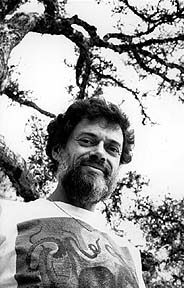
Terence McKenna
Terence McKenna was an American ethnobotanist and mystic. Born November 16, 1946, in Paonia. Died April 3, 2000, in San Rafael. Educated at University of California, Berkeley and Antelope Valley High School.
Facts
19 facts · 2 confirmed by two sources · 5 cited · 12 from one source
Where this comes from
Papalocal keeps its own record. It started from these sources; what each one said is kept here as it was copied, so a change on their side never changes this page by itself. Tap one to read its version.
What Wikidata says · copied November 14, 2026 · revision 2565502850
- Described as
- American ethnobotanist and mystic (1946–2000)
- Other names
- Terence Kemp McKenna
- Born
- November 16, 1946 · 3 references
- Died
- April 3, 2000 · 3 references
- Born in
- Paonia
- Died in
- San Rafael
- Cause of death
- brain cancer
- Citizen of
- United States
- Occupation
- writer; anthropologist; ethnobotanist; ethnologist · 1 reference; linguist · 1 reference; author · 1 reference; biologist · 1 reference
- Education
- University of California, Berkeley; Antelope Valley High School · 1 reference
- Field
- ethnobotany
- Children
- Klea McKenna
- Siblings
- Dennis McKenna · 1 reference
- Website
- http://www.levity.com/eschaton/
- Wikipedias with a page
- 40
Wikidata item Q380558 (wikidata.org/wiki/Q380558), public domain (CC0). Copied November 14, 2026.
What Wikipedia says · copied November 14, 2026 · revision 1380611494
Terence Kemp McKenna (November 16, 1946 – April 3, 2000) was an American ethnobotanist, lecturer, and author who advocated for the responsible use of naturally occurring psychedelic plants and mushrooms. He spoke and wrote about a variety of subjects, including psychedelic drugs, plant-based entheogens, shamanism, metaphysics, alchemy, language, philosophy, culture, technology, ethnomycology, environmentalism, and the theoretical origins of human consciousness. He was called the "Timothy Leary of the '90s", "one of the leading authorities on the ontological foundations of shamanism", and the "intellectual voice of rave culture". Critical reception of McKenna's work was deeply polarized, with critics accusing him of promoting dangerous ideas and questioning his sanity, while others praised his writing as groundbreaking, humorous, and intellectually provocative.
Born in Colorado, he developed a fascination with nature, psychology, and visionary experiences at a young age. His travels through Asia and South America in the 1960s and '70s shaped his theories on plant-based psychedelics, particularly psilocybin mushrooms, which he helped popularize through cultivation methods and writings. McKenna became a countercultural icon in the 1980s and '90s, delivering lectures on psychedelics, language, and metaphysics while publishing influential books and co-founding Botanical Dimensions in Hawaii. He died in 2000 from brain cancer.
McKenna was a prominent advocate for the responsible use of natural psychedelics—particularly psilocybin mushrooms, ayahuasca, and DMT—which he believed enabled access to profound visionary experiences, alternate dimensions, and communication with intelligent entities. He opposed synthetic drugs and organized religion, favoring shamanic traditions and direct, plant-based spiritual experiences. He speculated that psilocybin mushrooms might be intelligent extraterrestrial life and proposed the controversial "stoned ape" theory, arguing that psychedelics catalyzed human evolution, language, and culture. His broader philosophy envisioned an "archaic revival" as a healing response to the ills of modern civilization.
McKenna formulated a concept about the nature of time based on fractal patterns he claimed to have discovered in the I Ching, which he called novelty theory, proposing that this predicted the end of time, and a transition of consciousness in the year 2012. His promotion of novelty theory and its connection to the Maya calendar is credited as one of the factors leading to the widespread beliefs about the 2012 phenomenon. Novelty theory is considered pseudoscience.
- Born, in its opening lines
- November 16, 1946
- Died, in its opening lines
- April 3, 2000
From the Wikipedia article “Terence McKenna” (en.wikipedia.org/wiki/Terence_McKenna), by its contributors, under CC BY-SA 4.0 (creativecommons.org/licenses/by-sa/4.0/). Copied November 14, 2026; not changed.
Confirmed Two sources agree. Cited One source, and it names where it got it. One source One source, without a reference of its own. Sources disagree The sources disagree. We show the best-supported value and keep theirs below.
