
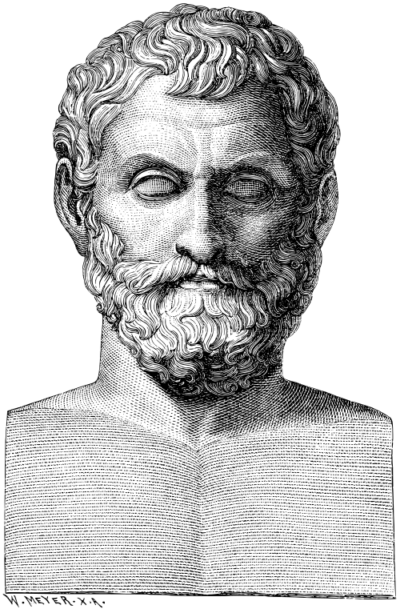
Thales
Thales was an ancient Greek philosopher and mathematician. Born 625 BC, in Miletus. Died 540s BC, in Miletus. Known for Thales' theorem.
Facts
20 facts · 0 confirmed by two sources · 8 cited · 12 from one source
Where this comes from
Papalocal keeps its own record. It started from these sources; what each one said is kept here as it was copied, so a change on their side never changes this page by itself. Tap one to read its version.
What Wikidata says · copied November 16, 2026 · revision 2567672276
- Described as
- ancient Greek philosopher and mathematician
- Other names
- Thales of Miletus
- Born
- 625 BC · 7 references
- Died
- 540s BC · 4 references
- Born in
- Miletus · 1 reference
- Died in
- Miletus
- Cause of death
- heat stroke · 1 reference
- Occupation
- mathematician · 1 reference; philosopher · 3 references; astronomer; physicist · 1 reference; engineer; writer · 1 reference; geometer; teacher
- Known for
- Thales' theorem
- Field
- philosophy; mathematics
- Father
- Examyas
- Mother
- Сleobulina
- Religion
- monism
- Lived in
- Miletus
- Wikipedias with a page
- 162
Wikidata item Q36303 (wikidata.org/wiki/Q36303), public domain (CC0). Copied November 16, 2026.
What Wikipedia says · copied November 16, 2026 · revision 1375896971
Thales of Miletus ( THAY-leez; Ancient Greek: Θαλῆς; c. 626/623 – c. 548/545 BC) was a pre-Socratic Greek philosopher from Miletus in Ionia, Asia Minor. Thales was one of the Seven Sages, founding figures of Ancient Greece.
Beginning in eighteenth-century historiography, many came to regard him as the first philosopher in the Greek tradition, breaking from the prior use of mythology to explain the world and instead using natural philosophy. He is thus otherwise referred to as the first to have engaged in mathematics, science, and deductive reasoning.
Thales's view that all of nature is based on the existence of a single ultimate substance, which he theorized to be water, was widely influential among the philosophers of his time. Thales thought the Earth floated on water.
In mathematics, Thales is the namesake of Thales's theorem, and the intercept theorem can also be referred to as Thales's theorem. Thales was said to have calculated the heights of the pyramids and the distance of ships from the shore. In science, Thales was an astronomer who reportedly predicted the weather and a solar eclipse. The discovery of the position of the constellation Ursa Major is also attributed to Thales, as well as the timings of the solstices and equinoxes. He was also an engineer, known for having allowed the Lydian army to cross the Halys River. Plutarch wrote that "at that time, Thales alone had raised philosophy from mere speculation to practice."
From the Wikipedia article “Thales of Miletus” (en.wikipedia.org/wiki/Thales_of_Miletus), by its contributors, under CC BY-SA 4.0 (creativecommons.org/licenses/by-sa/4.0/). Copied November 16, 2026; not changed.
Confirmed Two sources agree. Cited One source, and it names where it got it. One source One source, without a reference of its own. Sources disagree The sources disagree. We show the best-supported value and keep theirs below.
