
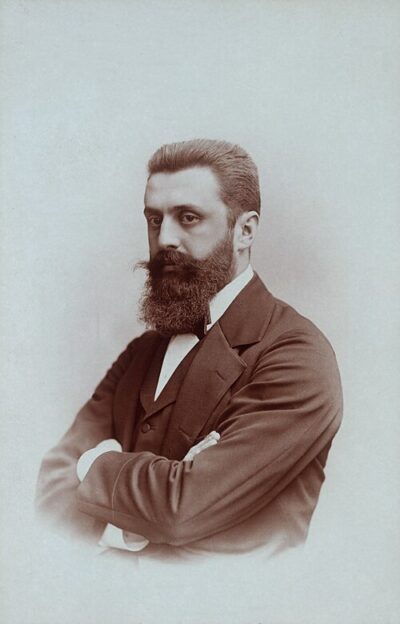
Theodor Herzl
Theodor Herzl was an Austro-Hungarian journalist, writer, and father of modern political Zionism. Born May 2, 1860, in Pest. Died July 3, 1904, in Edlach an der Rax. Positions held include chairperson (1897–1904). Educated at University of Vienna. Awards include honorary citizen of Erzsébetváros (Budapest District VII) and 5th class, Order of the Medjidie.
Facts
29 facts · 2 confirmed by two sources · 14 cited · 13 from one source
Where this comes from
Papalocal keeps its own record. It started from these sources; what each one said is kept here as it was copied, so a change on their side never changes this page by itself. Tap one to read its version.
What Wikidata says · copied November 16, 2026 · revision 2567479839
- Described as
- Austro-Hungarian journalist, writer, and father of modern political Zionism (1860–1904)
- Other names
- Tivadar Herzl, Benjamin Ze’ev Herzl
- Born
- May 2, 1860 · 11 references
- Died
- July 3, 1904 · 11 references
- Born in
- Pest · 1 reference
- Died in
- Edlach an der Rax · 2 references
- Buried in
- Mount Herzl (1949–)
- Cause of death
- pneumonia
- Name at birth
- בִּנְיָמִין זְאֵב הֶרְצֵל
- Citizen of
- Hungary
- Occupation
- journalist · 2 references; lawyer; writer · 2 references; politician · 2 references; playwright · 2 references; literary critic · 1 reference; critic · 1 reference
- Positions held
- chairperson (1897–1904)
- Education
- University of Vienna
- Awards
- honorary citizen of Erzsébetváros (Budapest District VII) (2017); 5th class, Order of the Medjidie (2017) · 1 reference
- Field
- creative and professional writing · 1 reference; journalism · 1 reference; literary criticism · 1 reference; Zionism · 1 reference
- Spouse
- Julie Naschauer (1868–1904) · 1 reference
- Children
- Hans Herzl · 1 reference
- Mother
- Jeanette Herzl
- Siblings
- Pauline Herzl
- Religion
- Judaism
- Lived in
- Vienna
- Wikipedias with a page
- 104
Wikidata item Q44003 (wikidata.org/wiki/Q44003), public domain (CC0). Copied November 16, 2026.
What Wikipedia says · copied November 16, 2026 · revision 1385034528
Theodor Herzl (2 May 1860 – 3 July 1904) was a Hungarian Jewish journalist and lawyer who was the father of modern political Zionism. Herzl formed the Zionist Organization and promoted Jewish immigration to Palestine, which, in the late 19th century was part of the Ottoman Empire, in an effort to form a Jewish state. Due to his Zionist work, he is known in Hebrew as Chozeh HaMedinah (חוֹזֵה הַמְדִינָה), lit. 'Visionary of the State'. He is specifically mentioned in the Israeli Declaration of Independence and is officially referred to as "the spiritual father of the Jewish State".
Herzl was born in Pest, then part of the Kingdom of Hungary, to a prosperous Neolog Jewish family. After a brief legal career in Vienna, he became the Paris correspondent for the Viennese newspaper Neue Freie Presse. Confronted with antisemitic events in Vienna, he reached the conclusion that anti-Jewish sentiment would make Jewish assimilation impossible, and that the only solution for Jews was the establishment of a Jewish state. In 1896, Herzl published the pamphlet Der Judenstaat, in which he elaborated his visions of a Jewish homeland. His ideas attracted international attention, and rapidly established him as a major figure in the Jewish world.
In 1897, Herzl convened the First Zionist Congress at the Stadtcasino in Basel, Switzerland, and was elected president of the Zionist Organization. He began a series of diplomatic initiatives to build support for a Jewish state, appealing unsuccessfully to German emperor Wilhelm II and Ottoman sultan Abdul Hamid II. At the Sixth Zionist Congress in 1903, Herzl presented the Uganda Scheme, endorsed by Colonial Secretary Joseph Chamberlain on behalf of the British government. The proposal, which sought to create a temporary refuge for the Jews in British East Africa following the Kishinev pogrom, was met with strong opposition and ultimately rejected. Herzl died of a heart ailment in 1904 at the age of 44, and was buried in Vienna. In 1949, his remains were taken to Israel and reinterred on Mount Herzl.
- Born, in its opening lines
- May 2, 1860
- Died, in its opening lines
- July 3, 1904
From the Wikipedia article “Theodor Herzl” (en.wikipedia.org/wiki/Theodor_Herzl), by its contributors, under CC BY-SA 4.0 (creativecommons.org/licenses/by-sa/4.0/). Copied November 16, 2026; not changed.
Confirmed Two sources agree. Cited One source, and it names where it got it. One source One source, without a reference of its own. Sources disagree The sources disagree. We show the best-supported value and keep theirs below.
