
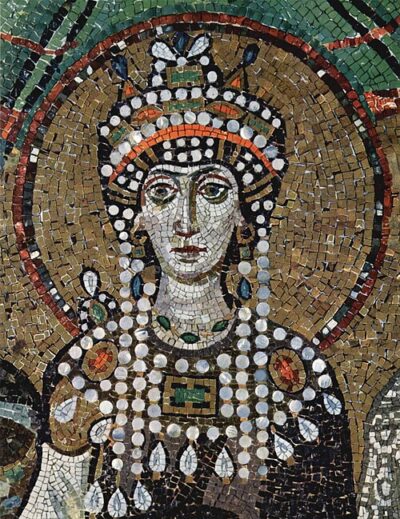
Theodora
Theodora was a Byzantine empress from 527 to 548. Born 500, in Paphlagonia. Died June 28, 548, in Constantinople. Positions held include Byzantine emperor (527–548).
Facts
17 facts · 0 confirmed by two sources · 6 cited · 10 from one source · 1 where the sources disagree
What’s different
- Born: we show 500 (Sources disagree). Wikidata also lists 497
Where this comes from
Papalocal keeps its own record. It started from these sources; what each one said is kept here as it was copied, so a change on their side never changes this page by itself. Tap one to read its version.
What Wikidata says · copied November 16, 2026 · revision 2558255102
- Described as
- Byzantine empress from 527 to 548
- Other names
- Teodora, Imperatrice di Bisanzio, Empress Theodora, Empress Theodora of Byzantium
- Born
- 500 · 1 reference; 497 · 1 reference
- Died
- June 28, 548 · 1 reference
- Born in
- Paphlagonia · 1 reference
- Died in
- Constantinople · 1 reference
- Buried in
- Church of the Holy Apostles
- Cause of death
- breast cancer
- Citizen of
- Byzantine Empire
- Occupation
- dancer; monarch
- Positions held
- Byzantine emperor (527–548)
- Spouse
- Justinian I · 3 references
- Children
- Ioannes; NN · 1 reference
- Father
- Acacius · 1 reference
- Siblings
- Comito; Anastasia
- Religion
- monophysitism
- Wikipedias with a page
- 64
Wikidata item Q204843 (wikidata.org/wiki/Q204843), public domain (CC0). Copied November 16, 2026.
What Wikipedia says · copied November 16, 2026 · revision 1384962370
Theodora (; Greek: Θεοδώρα; c. 490/500 – 28 June 548) was the wife of emperor Justinian I and Eastern Roman empress from 527 until her death. Theodora was one of Justinian's chief political advisers. She is recognized as a saint in the Eastern Orthodox and Oriental Orthodox Churches, and commemorated on 14 November.
She was of humble origins, having been born to a bear-keeper in Constantinople. She worked as a courtesan and actress in her youth. She likely met Justinian sometime before 524. They subsequently married and Theodora was crowned empress when Justinian became emperor in 527.
She played a crucial role in the suppression of the Nika riots in 532. Theodora and Justinian ordered construction of many grand public works, including the Hagia Sophia. According to Procopius, she banished the brothel-keepers and set free the women. She also engaged in court intrigues, such as the exile of John the Cappadocian, and the exile and death of Pope Silverius and the elevation of Pope Vigilius. She and her husband supported opposite sides in the Chalcedonian schism between Christian Monophysites/Miaphysites and Chalcedonian Christianity, which led Justinian to be occasionally merciful to the Miaphysites despite being a Chalcedonian himself.
She died of cancer in 548. Much of the primary narrative of her life comes from the works of Procopius, who presents starkly diverging views in his public and private writings. Publicly, he wrote glowingly of her, but his Secret Histories portrays her as shameless, cruel and lustful, though loyal. Historians are divided as to the accuracy of Procopius's portrayals. Nevertheless, Theodora achieved lasting cultural interest, inspiring art, plays, operas, films, novels, and worship.
From the Wikipedia article “Theodora (wife of Justinian I)” (en.wikipedia.org/wiki/Theodora_(wife_of_Justinian_I)), by its contributors, under CC BY-SA 4.0 (creativecommons.org/licenses/by-sa/4.0/). Copied November 16, 2026; not changed.
Confirmed Two sources agree. Cited One source, and it names where it got it. One source One source, without a reference of its own. Sources disagree The sources disagree. We show the best-supported value and keep theirs below.
