
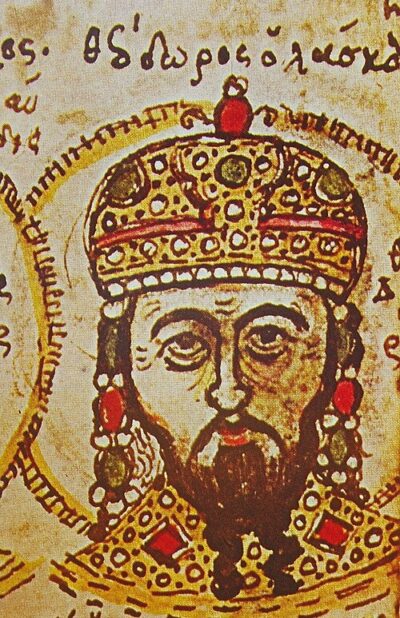
Theodore I Laskaris
Theodore I Laskaris was the 13th-century emperor of Nicaea. Born 1174, in Constantinople. Died November 1221, in İznik. Positions held include Emperor of Nicaea (1205–1222).
Facts
22 facts · 1 confirmed by two sources · 2 cited · 18 from one source · 1 where the sources disagree
What’s different
- Born: we show 1174 (Sources disagree). Wikipedia says c. 1175
Where this comes from
Papalocal keeps its own record. It started from these sources; what each one said is kept here as it was copied, so a change on their side never changes this page by itself. Tap one to read its version.
What Wikidata says · copied November 16, 2026 · revision 2569045871
- Described as
- 13th-century emperor of Nicaea
- Born
- 1174
- Died
- November 1221 · 1 reference
- Born in
- Constantinople
- Died in
- İznik
- Citizen of
- Byzantine Empire
- Occupation
- ruler
- Positions held
- Emperor of Nicaea (1205–1222)
- Spouse
- Anna Komnene Angelina; Philippa of Armenia; Marie de Courtenay · 2 references
- Children
- Maria Laskarina; Sophia Eudokia Laskarina · 1 reference; Nicholas Laskaris; Constantin Laskaris · 1 reference; Irene Laskarina · 1 reference
- Father
- Manuel Láscaris
- Mother
- Ioanna Karatzaina
- Siblings
- Konstantinos Laskaris; Alexios Laskaris; Georg Laskaris; Isaac Laskaris; Manuel Laskaris
- Wikipedias with a page
- 47
Wikidata item Q37086 (wikidata.org/wiki/Q37086), public domain (CC0). Copied November 16, 2026.
What Wikipedia says · copied November 16, 2026 · revision 1374669319
Theodore I Komnenos Laskaris or Lascaris (Greek: Θεόδωρος Κομνηνὸς Λάσκαρις, romanized: Theodōros Komnēnós Láskaris; c. 1175 – November 1221) was the first emperor of Nicaea—a successor state of the Byzantine Empire—from 1205 to his death. Although he was born to an obscure aristocratic family, his mother was related to the imperial Komnenos clan. He married Anna, a younger daughter of Emperor Alexios III Angelos in 1200. He received the title of despot before 1203, demonstrating his right to succeed his father-in-law on the throne.
The Fourth Crusade forced Alexios III to flee from Constantinople in 1203. Theodore was imprisoned by the crusaders (commonly referred to as "Latins" by the Byzantines), but he escaped. After crossing the Bosporus into Asia Minor (in present-day Turkey), he started to organise the local Greeks' resistance against the Latins in Bithynia in his father-in-law's name. He concluded an alliance with the Seljuq sultan of Rum, but he could not stop the Latins' expansion. Neither could he prevent a claimant to the imperial throne, Alexios Komnenos, from establishing a Byzantine successor state, the Empire of Trebizond, in northern Asia Minor. Theodore's position consolidated only after Tzar Kaloyan of Bulgaria inflicted a crushing defeat on the Latins in the Battle of Adrianople (in Thrace) in 1205.
Greeks fleeing from the Latin Empire — the crusader state that emerged in the Byzantine core territories — swarmed to Asia Minor to live under Theodore's rule. The Latins captured Theodore's father-in-law and made an alliance with Alexios I of Trebizond, but Theodore routed their united troops. He secured the support of most Bithynian aristocrats and seized the domains of those who resisted him. In 1205, he assumed the traditional titles of the Byzantine emperors. Three years later, he convoked a Church council to elect a new Orthodox patriarch of Constantinople. The new patriarch crowned Theodore emperor and established his seat at Theodore's capital, Nicaea. The Orthodox population of the Latin Empire regarded Theodore as the main defender of their Church, but the rulers of Epirus—a realm that developed in the western regions of the Byzantine Empire—debated the legality of his coronation.
Theodore's father-in-law did not abandon his claim to the throne. After being released from prison, Alexios III persuaded the Seljuqs to invade Nicaea, but Theodore defeated them in 1211. The Latin Emperor Henry of Flanders captured important fortresses in western Asia Minor in 1212, but he ran out of soldiers and could not place garrisons in them. Henry implicitly acknowledged the existence of the Empire of Nicaea in his peace treaty with Theodore. Theodore conquered western Paphlagonia on the Black Sea coast from Alexios I of Trebizond. Around 1220, Theodore tried to persuade the Latins of Constantinople to acknowledge his rule, but they refused. Theodore established a powerful state, located in the vicinity of Constantinople, which enabled his successors to expel the Latins from the city and revive the Byzantine Empire in 1261.
- Born, in its opening lines
- c. 1175
- Died, in its opening lines
- November 1221
From the Wikipedia article “Theodore I Laskaris” (en.wikipedia.org/wiki/Theodore_I_Laskaris), by its contributors, under CC BY-SA 4.0 (creativecommons.org/licenses/by-sa/4.0/). Copied November 16, 2026; not changed.
Confirmed Two sources agree. Cited One source, and it names where it got it. One source One source, without a reference of its own. Sources disagree The sources disagree. We show the best-supported value and keep theirs below.
