
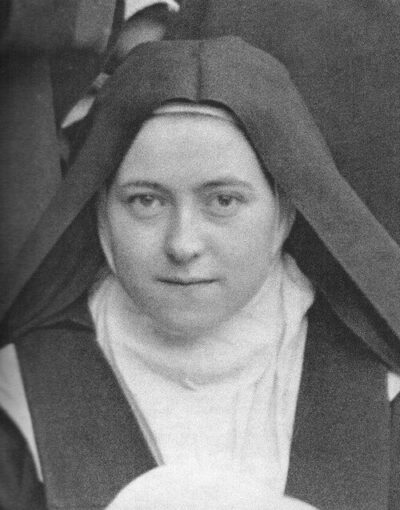
Thérèse of Lisieux
Thérèse of Lisieux was a French Discalced Carmelite nun, Doctor of the Church. Born January 2, 1873, in Alençon. Died September 30, 1897, in Lisieux. Known for The Story of a Soul.
Facts
25 facts · 2 confirmed by two sources · 9 cited · 14 from one source
Where this comes from
Papalocal keeps its own record. It started from these sources; what each one said is kept here as it was copied, so a change on their side never changes this page by itself. Tap one to read its version.
What Wikidata says · copied November 16, 2026 · revision 2565974450
- Described as
- French Discalced Carmelite nun, Doctor of the Church (1873–1897)
- Other names
- Therese of Lisieux, Saint Therese of Lisieux, Therese Martin, Saint Therese of the Child Jesus and the Holy Face, O.C.D., Marie-Françoise-Therese Martin, Santa Teresa de Lisieux, Teresita del Nino Jesus, The Little Flower, St Theresa of the Child Jesus, Marie-Françoise Martin, Marie-Françoise-Thérèse Martin
- Born
- January 2, 1873 · 11 references
- Died
- September 30, 1897 · 11 references
- Born in
- Alençon · 1 reference
- Died in
- Lisieux · 1 reference
- Buried in
- Lisieux
- Cause of death
- tuberculosis
- Name at birth
- maria
- Citizen of
- France
- Occupation
- theologian; playwright; writer · 1 reference; master of novices; missionary; nun · 1 reference
- Known for
- The Story of a Soul · 2 references
- Father
- Louis Martin · 1 reference
- Mother
- Azélie-Marie Guérin Martin · 1 reference
- Siblings
- Marie-Pauline Martin; Céline Martin · 1 reference; Léonie Martin · 1 reference; Marie-Louise Martin · 1 reference
- Religion
- Catholicism
- Lived in
- Les Buissonnets; carmel de Lisieux · 1 reference
- Nickname
- The Little Flower
- Wikipedias with a page
- 88
Wikidata item Q181715 (wikidata.org/wiki/Q181715), public domain (CC0). Copied November 16, 2026.
What Wikipedia says · copied November 16, 2026 · revision 1384652809
Thérèse of Lisieux (born Marie Françoise-Thérèse Martin; 2 January 1873 – 30 September 1897), religious name Therese of the Child Jesus and the Holy Face was a French Discalced Carmelite. She is popularly known in English as the "Little Flower of Jesus", or simply the "Little Flower", and in French and German as the "little Therese", in contrast to Teresa of Avila, who is called the "great Therese").
Therese has been a highly influential model of sanctity for Catholics and for others because of the simplicity and practicality of her approach to the spiritual life. She is one of the most popular saints in the history of the church, although she was obscure during her lifetime. Pope Pius X called her "the greatest saint of modern times".
Born to two future saints, Therese felt an early call to religious life and, after overcoming various obstacles, in 1888, at age 15, she became a nun and joined two of her elder sisters in the cloistered Carmelite community of Lisieux in Normandy (another sister, Céline, also later joined the order). After nine years as a Carmelite nun, having fulfilled various offices such as sacristan and assistant to the novice mistress, in her last eighteen months in Carmel she fell into a night of faith, in which she is said to have felt Jesus was absent and been tormented by doubts that God existed. Therese died at the age of 24 from tuberculosis.
After her death, Therese became known globally through her spiritual memoir, The Story of a Soul, which explains her theology of the "Little Way". As a result of her immense popularity and reputation for holiness, she was quickly beatified and canonized by Pope Pius XI, who completed the process just 28 years after her death. In 1997, Pope John Paul II declared her a Doctor of the Church. Her feast day in the General Roman Calendar was 3 October from 1927 until it was moved in 1969 to 1 October. She is well known throughout the world, with the Basilica of Lisieux being the second most popular place of pilgrimage in France after Lourdes.
- Born, in its opening lines
- January 2, 1873
- Died, in its opening lines
- September 30, 1897
From the Wikipedia article “Thérèse of Lisieux” (en.wikipedia.org/wiki/Thérèse_of_Lisieux), by its contributors, under CC BY-SA 4.0 (creativecommons.org/licenses/by-sa/4.0/). Copied November 16, 2026; not changed.
Confirmed Two sources agree. Cited One source, and it names where it got it. One source One source, without a reference of its own. Sources disagree The sources disagree. We show the best-supported value and keep theirs below.
