
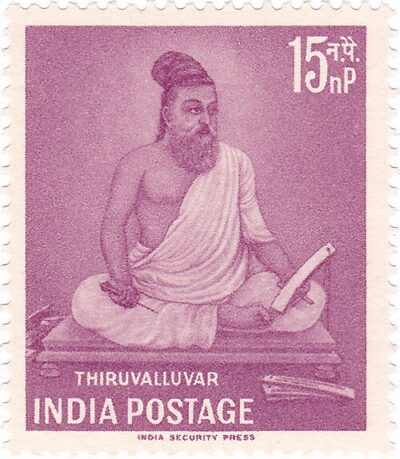
Thiruvalluvar
Thiruvalluvar was a Tamil poet and philosopher.
Facts
7 facts · 0 confirmed by two sources · 1 cited · 6 from one source
Where this comes from
Papalocal keeps its own record. It started from these sources; what each one said is kept here as it was copied, so a change on their side never changes this page by itself. Tap one to read its version.
What Wikidata says · copied November 16, 2026 · revision 2558259427
- Described as
- Tamil poet and philosopher
- Other names
- Tiruvalluvar
- Born in
- Mylapore · 1 reference
- Citizen of
- Chola dynasty
- Occupation
- philosopher; writer; poet
- Religion
- Hinduism; Jainism
- Wikipedias with a page
- 35
Wikidata item Q2353373 (wikidata.org/wiki/Q2353373), public domain (CC0). Copied November 16, 2026.
What Wikipedia says · copied November 16, 2026 · revision 1381266461
Thiruvalluvar (commonly known as Valluvar) was an Indian philosopher and a Tamil-language poet of the post-Sangam era. He is best known as the author of the Tirukkuṟaḷ, a collection of couplets on ethics, political and economic matters, and love. The text is considered an exceptional and widely cherished work of Tamil literature.
Almost no authentic information is available about Valluvar, states Kamil Zvelebil – a scholar of Tamil literature. His life and likely background are variously inferred from his literary works by different biographers. There are unauthentic hagiographic and legendary accounts of Valluvar's life, and all major Indian religions, as well as Christian missionaries of the 19th century, have tried to claim him as secretly inspired (crypto-) or originally belonging to their tradition. Little is known with certainty about his family background, religious affiliation, or birthplace. He is believed to have lived at least in the town of Mylapore (a neighbourhood of the present-day Chennai), and his floruit is dated variously from fourth century BCE to early fifth century CE, based on the traditional accounts and the linguistic analyses of his writings. Kamil Zvelebil infers the Tirukkuṟaḷ and Valluvar are best dated to around 500 CE.
Valluvar has influenced a wide range of scholars down the ages since his time across the ethical, social, political, economical, religious, philosophical, and spiritual spheres. He has long been venerated as a great sage, and his literary works a classic of Tamil culture.
From the Wikipedia article “Thiruvalluvar” (en.wikipedia.org/wiki/Thiruvalluvar), by its contributors, under CC BY-SA 4.0 (creativecommons.org/licenses/by-sa/4.0/). Copied November 16, 2026; not changed.
Confirmed Two sources agree. Cited One source, and it names where it got it. One source One source, without a reference of its own. Sources disagree The sources disagree. We show the best-supported value and keep theirs below.
