
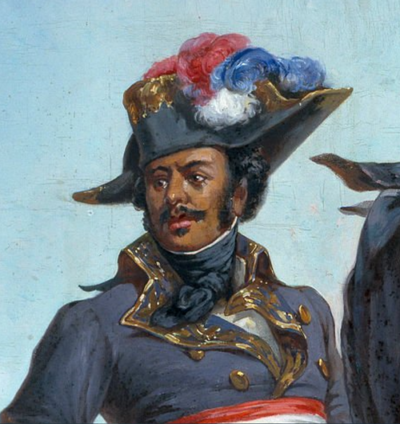
Thomas-Alexandre Dumas
Thomas-Alexandre Dumas was a French general. Born March 25, 1762, in Jérémie. Died February 26, 1806, in Villers-Cotterêts. Awards include list of names inscribed on the Arc de Triomphe.
Facts
20 facts · 2 confirmed by two sources · 7 cited · 11 from one source
Where this comes from
Papalocal keeps its own record. It started from these sources; what each one said is kept here as it was copied, so a change on their side never changes this page by itself. Tap one to read its version.
What Wikidata says · copied November 16, 2026 · revision 2567410301
- Described as
- French general (1762–1806)
- Other names
- Alexandre Dumas, General Dumas, Thomas-Alexandre, Thomas Alexandre Dumas, Thomas-Alexandre Dumas Davy de la Pailleterie
- Born
- March 25, 1762 · 5 references
- Died
- February 26, 1806 · 3 references
- Born in
- Jérémie · 1 reference
- Died in
- Villers-Cotterêts · 1 reference
- Buried in
- Communal Cemetery of Villers-Cotterêts · 1 reference
- Cause of death
- myocardial infarction
- Citizen of
- Kingdom of France (–1792); French First Republic (1792–1804); First French Empire (1804–)
- Occupation
- military officer; soldier · 1 reference
- Awards
- list of names inscribed on the Arc de Triomphe
- Field
- military · 1 reference
- Spouse
- Marie-Louise-Élisabeth Labouret Dumas
- Children
- Alexandre Dumas · 1 reference
- Father
- Alexandre Antoine Davy de la Pailleterie
- Mother
- Marie-Cessette Dumas
- Military branch
- French Army
- Military rank
- general · 1 reference; Major General
- Wikipedias with a page
- 31
Wikidata item Q572684 (wikidata.org/wiki/Q572684), public domain (CC0). Copied November 16, 2026.
What Wikipedia says · copied November 16, 2026 · revision 1379855063
Divisional-General Thomas-Alexandre Dumas (known before as Thomas-Alexandre Davy de la Pailleterie, pronounced in French: [tɔmɑ alɛksɑ̃dʁ davi də la pajət(ə)ʁi]; 25 March 1762 – 26 February 1806) was a French Army officer who served in the French Revolutionary Wars. Along with fellow French officers Joseph Serrant and Toussaint Louverture, Abram Petrovich Gannibal from Imperial Russia and Władysław Franciszek Jabłonowski from Poland, Thomas-Alexandre Dumas was noted as a man of African descent (in Dumas's case, through his mother) leading European troops as a general officer. All four commanded as officers in the French Army and apart from Gannibal, who was only captain and engineer-sapper in the Army of Louis XV during his formative years, they all gained their general ranks in the French Army, about four decades after Gannibal had done the same in Russia. Yet Dumas was the first Black man in the French military to become brigade general, divisional general, and general-in-chief of a French army.
Born in Saint-Domingue, Thomas-Alexandre was the son of Marquis Alexandre Antoine Davy de la Pailleterie, a French nobleman, and of Marie-Cessette Dumas, an enslaved woman of African descent. He was born into slavery because of his mother's status, but his father took him to France in 1776 and had him educated. Slavery had been illegal in metropolitan France since 1315 and thus any slave would be freed de facto by being in France. His father helped him enter the French military.
Dumas played a large role in the French Revolutionary Wars. Having entered the military in 1786 at age 24 as a private, by age 31 he commanded 53,000 troops as the General-in-Chief of the French Army of the Alps. Dumas's victory in opening the high Alpine passes in 1794 enabled the French to initiate their Second Italian Campaign against the Austrian Empire. During the battles in Italy, Austrian troops nicknamed Dumas the Schwarzer Teufel ("Black Devil", Diable Noir in French) in 1797. The French—notably Napoleon—nicknamed him "the Horatius Cocles of the Tyrol" (after a hero who had saved ancient Rome) for defeating a squadron of enemy troops at a bridge over the Eisack River in Clausen (today Klausen, or Chiusa, Italy) in March 1797.
Dumas participated in the French attempt to conquer Egypt and the Levant during the Expédition d’Égypte of 1798–1801 when he was a commander of the French cavalry forces. On the march from Alexandria to Cairo, he clashed verbally with the expedition's supreme commander Napoleon Bonaparte, under whom he had served in the Italian campaigns. In March 1799, Dumas left Egypt on an unsound vessel, which was forced to run aground in the southern Italian Kingdom of Naples, where he was taken prisoner and thrown into a dungeon. He languished there until the spring of 1801. Returning to France after his release, he and his wife had a son, Alexandre Dumas (1802–1870), who would become one of France's most widely-read authors. The son's most famous literary characters were inspired by his father.
- Born, in its opening lines
- March 25, 1762
- Died, in its opening lines
- February 26, 1806
From the Wikipedia article “Thomas-Alexandre Dumas” (en.wikipedia.org/wiki/Thomas-Alexandre_Dumas), by its contributors, under CC BY-SA 4.0 (creativecommons.org/licenses/by-sa/4.0/). Copied November 16, 2026; not changed.
Confirmed Two sources agree. Cited One source, and it names where it got it. One source One source, without a reference of its own. Sources disagree The sources disagree. We show the best-supported value and keep theirs below.
