
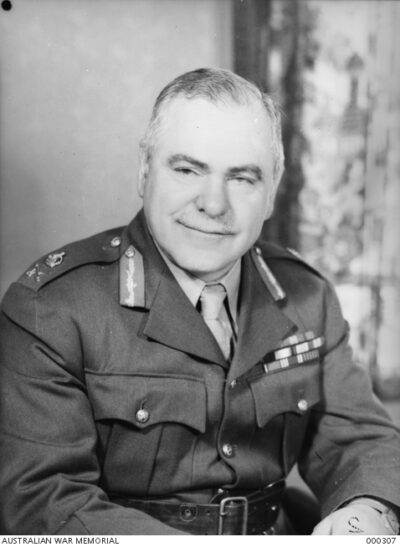
Thomas Blamey
Thomas Blamey was an Australian general of the First and Second World Wars. Born January 24, 1884, in Wagga Wagga. Died May 27, 1951, in Heidelberg. Positions held include Chief Commissioner of Victoria Police (1925–1936). Educated at Command and Staff College. Awards include Knight Commander of the Order of the Bath, Knight Grand Cross of the Order of the British Empire and Companion of the Order of St Michael and St George.
Facts
25 facts · 2 confirmed by two sources · 0 cited · 23 from one source
Where this comes from
Papalocal keeps its own record. It started from these sources; what each one said is kept here as it was copied, so a change on their side never changes this page by itself. Tap one to read its version.
What Wikidata says · copied November 17, 2026 · revision 2555584524
- Described as
- Australian general of the First and Second World Wars (1884-1951)
- Born
- January 24, 1884 · 3 references
- Died
- May 27, 1951 · 3 references
- Born in
- Wagga Wagga
- Died in
- Heidelberg · 1 reference
- Citizen of
- Australia
- Occupation
- military personnel
- Positions held
- Chief Commissioner of Victoria Police (1925–1936)
- Education
- Command and Staff College
- Awards
- Knight Commander of the Order of the Bath; Knight Grand Cross of the Order of the British Empire; Companion of the Order of St Michael and St George; Croix de guerre 1914–1918; Knight Bachelor; Distinguished Service Order; Commander of the Order of Saint John; 1914–15 Star; Africa Star; Pacific Star; Defence Medal; Victory Medal (United Kingdom); War Medal 1939–1945; Australia Service Medal 1939–45; Efficiency Decoration
- Military branch
- Australian Army
- Military rank
- field marshal
- Wikipedias with a page
- 25
Wikidata item Q952813 (wikidata.org/wiki/Q952813), public domain (CC0). Copied November 17, 2026.
What Wikipedia says · copied November 17, 2026 · revision 1379823205
Field Marshal Sir Thomas Albert Blamey (24 January 1884 – 27 May 1951) was an Australian general of the First and Second World Wars. He is the only Australian to attain the rank of field marshal.
Blamey joined the Australian Army as a regular soldier in 1906 and attended the Staff College at Quetta. During the First World War, he participated in the landing at Anzac Cove on 25 April 1915, and served as a staff officer in the Gallipoli campaign, where he was mentioned in despatches for a daring raid behind enemy lines. He later served on the Western Front, where he distinguished himself in the planning for the Battle of Pozières. He rose to the rank of brigadier general. He served as chief of staff of the Australian Corps under Lieutenant General Sir John Monash, who credited him as a factor in the Corps' success in the Battle of Hamel, the Battle of Amiens and the Battle of the Hindenburg Line.
After the war, Blamey became the Deputy Chief of the General Staff, and was involved in the creation of the Royal Australian Air Force. He resigned from the regular Army in 1925 to become Chief Commissioner of the Victoria Police. Still, he remained in the Militia, rising to command the 3rd Division in 1931. As chief commissioner, Blamey set about dealing with the grievances that had led to the 1923 Victorian police strike, and implemented innovations such as police dogs and equipping vehicles with radios. His tenure as chief commissioner was marred by a scandal in which his police badge was found in a brothel, and a later attempt to cover up the shooting of a police officer led to his forced resignation in 1936.
During the Second World War, Blamey commanded the Second Australian Imperial Force and the I Corps in the Middle East. In the latter role, he commanded Australian and Commonwealth troops in the disastrous Battle of Greece. He attempted to protect Australian interests against British commanders who sought to disperse his forces. He was appointed deputy commander-in-chief of Middle East Command, and was promoted to general in 1941. In 1942, he returned to Australia as commander-in-chief of the Australian Military Forces and commander of Allied Land Forces in the South West Pacific Area under American General Douglas MacArthur. On the orders of MacArthur and Prime Minister John Curtin, he assumed personal command of New Guinea Force during the Kokoda Track campaign, and relieved Lieutenant General Sydney Rowell under controversial circumstances. He planned and carried out the significant and victorious Salamaua–Lae campaign but during the final campaigns of the war, he faced criticism of the Army's performance. He signed the Japanese Instrument of Surrender on behalf of Australia at Japan's ceremonial surrender in Tokyo Bay on 2 September 1945, and personally accepted the Japanese surrender on Morotai on 9 September.
- Born, in its opening lines
- January 24, 1884
- Died, in its opening lines
- May 27, 1951
From the Wikipedia article “Thomas Blamey” (en.wikipedia.org/wiki/Thomas_Blamey), by its contributors, under CC BY-SA 4.0 (creativecommons.org/licenses/by-sa/4.0/). Copied November 17, 2026; not changed.
Confirmed Two sources agree. Cited One source, and it names where it got it. One source One source, without a reference of its own. Sources disagree The sources disagree. We show the best-supported value and keep theirs below.
