
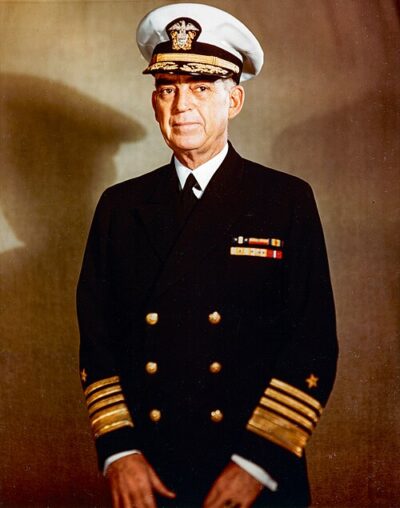
Thomas Cassin Kinkaid
Thomas Cassin Kinkaid was an United States Navy admiral. Born April 3, 1888, in Hanover. Died November 17, 1972, in Bethesda. Educated at United States Naval Academy and Naval War College. Awards include Legionnaire of Legion of Merit.
Facts
13 facts · 2 confirmed by two sources · 1 cited · 10 from one source
Where this comes from
Papalocal keeps its own record. It started from these sources; what each one said is kept here as it was copied, so a change on their side never changes this page by itself. Tap one to read its version.
What Wikidata says · copied November 16, 2026 · revision 2517994930
- Described as
- United States Navy admiral
- Other names
- Thomas C. Kinkaid
- Born
- April 3, 1888 · 3 references
- Died
- November 17, 1972 · 2 references
- Born in
- Hanover
- Died in
- Bethesda
- Buried in
- Arlington National Cemetery (1972) · 1 reference
- Name at birth
- Thomas Cassin Kinkaid
- Citizen of
- United States
- Occupation
- military officer
- Education
- United States Naval Academy; Naval War College · 1 reference
- Awards
- Legionnaire of Legion of Merit
- Military branch
- United States Navy
- Military rank
- admiral
- Wikipedias with a page
- 20
Wikidata item Q202365 (wikidata.org/wiki/Q202365), public domain (CC0). Copied November 16, 2026.
What Wikipedia says · copied November 16, 2026 · revision 1379832119
Thomas Cassin Kinkaid (3 April 1888 – 17 November 1972) was an admiral in the United States Navy, known for his service during World War II. He built a reputation as a "fighting admiral" in the aircraft carrier battles of 1942 and commanded the Allied forces in the Aleutian Islands Campaign. He was Commander Allied Naval Forces and the Seventh Fleet under General of the Army Douglas MacArthur in the Southwest Pacific Area, where he conducted numerous amphibious operations, and commanded an Allied fleet during the Battle of Leyte Gulf, the largest naval battle of World War II and the last naval battle between battleships in history.
Born into a naval family, Kinkaid was ranked in the lower half of his class on his graduation from the United States Naval Academy in June 1908. His early commissioned service was spent aboard battleships. In 1913, he began instruction in ordnance engineering and served in that field for many years. He saw action during the 1916 United States occupation of the Dominican Republic. During World War I, he was attached to the Royal Navy before serving as gunnery officer aboard the battleship USS Arizona. After the war, he was assistant chief of staff to the Commander U.S. Naval Detachment in Turkey. Kinkaid received his first command, the destroyer USS Isherwood, in 1924. He was executive officer of the battleship USS Colorado when the 1933 Long Beach earthquake struck, and participated in relief efforts. He received his second command in 1937, the heavy cruiser USS Indianapolis.
From 1938 to 1941, Kinkaid was a naval attaché in Italy and Yugoslavia. In the months prior to U.S. entry into World War II, he commanded a destroyer squadron. Promoted to rear admiral in 1941, he assumed command of a U.S. Pacific Fleet cruiser division. His cruisers defended the aircraft carrier USS Lexington during the Battle of the Coral Sea and USS Hornet during the Battle of Midway. After that battle, he took command of Task Force 16, a task force built around the carrier USS Enterprise, which he led during the long and difficult Solomon Islands campaign, participating in the Battles of the Eastern Solomons and the Santa Cruz Islands. Kinkaid was placed in charge of the North Pacific Force in January 1943 and commanded the operations that regained control of the Aleutian Islands. He was promoted to vice admiral in June 1943.
In November 1943, Kinkaid became Commander Allied Naval Forces South West Pacific Area, and commander of the Seventh Fleet, directing U.S. and Royal Australian Navy forces supporting the New Guinea campaign. During the Battle of the Surigao Strait, he commanded the Allied ships in the last naval battle between battleships in history. Following the demise of Japanese naval power in the region, the Allied navies supported the campaigns in the Philippines and Borneo. Kinkaid was promoted to admiral on 3 April 1945. After the Pacific War ended in August 1945, the Seventh Fleet assisted in operations on the Korean and China coasts. Admiral Kinkaid was Commander Eastern Sea Frontier and the Sixteenth Fleet from 1946 until his retirement in May 1950. He was a member of the National Security Training Commission for much of the rest of the decade. He also served with the American Battle Monuments Commission for 15 years.
- Born, in its opening lines
- April 3, 1888
- Died, in its opening lines
- November 17, 1972
From the Wikipedia article “Thomas C. Kinkaid” (en.wikipedia.org/wiki/Thomas_C._Kinkaid), by its contributors, under CC BY-SA 4.0 (creativecommons.org/licenses/by-sa/4.0/). Copied November 16, 2026; not changed.
Confirmed Two sources agree. Cited One source, and it names where it got it. One source One source, without a reference of its own. Sources disagree The sources disagree. We show the best-supported value and keep theirs below.
