
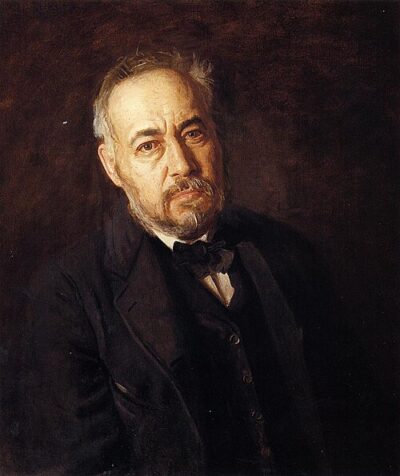
Thomas Eakins
Thomas Eakins was an American painter. Born July 25, 1844, in Philadelphia. Died June 25, 1916, in Philadelphia. Known for The Chess Players, The Gross Clinic and Swimming. Educated at Pennsylvania Academy of the Fine Arts and Beaux-Arts de Paris.
Facts
30 facts · 2 confirmed by two sources · 9 cited · 19 from one source
Where this comes from
Papalocal keeps its own record. It started from these sources; what each one said is kept here as it was copied, so a change on their side never changes this page by itself. Tap one to read its version.
What Wikidata says · copied November 13, 2026 · revision 2558256157
- Described as
- American painter (1844–1916)
- Other names
- Thomas Cowperthwait Eakins, Thomas Cowperthwaite Eakins, C.D. Cook, Eakins
- Born
- July 25, 1844 · 15 references
- Died
- June 25, 1916 · 14 references
- Born in
- Philadelphia · 4 references
- Died in
- Philadelphia · 4 references
- Buried in
- The Woodlands
- Citizen of
- United States
- Occupation
- painter · 3 references; sculptor · 2 references; photographer · 2 references; art educator
- Worked for
- Drexel University; Pennsylvania Academy of the Fine Arts · 1 reference
- Education
- Pennsylvania Academy of the Fine Arts; Beaux-Arts de Paris
- Genre
- portrait painting; painting · 1 reference; photographer · 1 reference; portrait · 1 reference; genre art · 1 reference; figure · 1 reference
- Known for
- The Chess Players; The Gross Clinic; Swimming; Max Schmitt in a Single Scull; Miss Amelia Van Buren
- Field
- painting; photography; art of sculpture
- Spouse
- Susan Macdowell Eakins · 1 reference
- Website
- http://www.thomaseakins.org
- Wikipedias with a page
- 52
Wikidata item Q214905 (wikidata.org/wiki/Q214905), public domain (CC0). Copied November 13, 2026.
What Wikipedia says · copied November 13, 2026 · revision 1368845098
Thomas Cowperthwait Eakins (; July 25, 1844 – June 25, 1916) was an American realist painter, photographer, sculptor, and fine arts educator. He is widely acknowledged to be one of the most important American artists.
For the length of his professional career, from the early 1870s until his health began to fail some 40 years later, Eakins worked exactingly from life, choosing as his subject the people of his hometown of Philadelphia. He painted several hundred portraits, usually of friends, family members, or prominent people in the arts, sciences, medicine, and clergy. Taken en masse, the portraits offer an overview of the intellectual life of contemporary Philadelphia of the late 19th and early 20th centuries.
In addition, Eakins produced a number of large paintings set in the offices, streets, parks, rivers, arenas, and surgical amphitheaters of his city. These active outdoor venues allowed him to paint the subject that most inspired him: the nude or lightly clad figure in motion. In the process, he could model the forms of the body in full sunlight, and create images of deep space utilizing his studies in perspective. Eakins took keen interest in new motion photography, a field in which he is now seen as an innovator.
Eakins was also an educator, and his instruction was a highly influential presence in American art. The difficulties he encountered as an artist were seeking to paint portraits and figures realistically as behavioral and sexual scandals truncated his success and challenged his reputation.
Eakins was a controversial figure whose work received little recognition during his lifetime. Since his death, he has been celebrated by American art historians as "the strongest, most profound realist in nineteenth- and early-twentieth-century American art".
- Born, in its opening lines
- July 25, 1844
- Died, in its opening lines
- June 25, 1916
From the Wikipedia article “Thomas Eakins” (en.wikipedia.org/wiki/Thomas_Eakins), by its contributors, under CC BY-SA 4.0 (creativecommons.org/licenses/by-sa/4.0/). Copied November 13, 2026; not changed.
Confirmed Two sources agree. Cited One source, and it names where it got it. One source One source, without a reference of its own. Sources disagree The sources disagree. We show the best-supported value and keep theirs below.
