
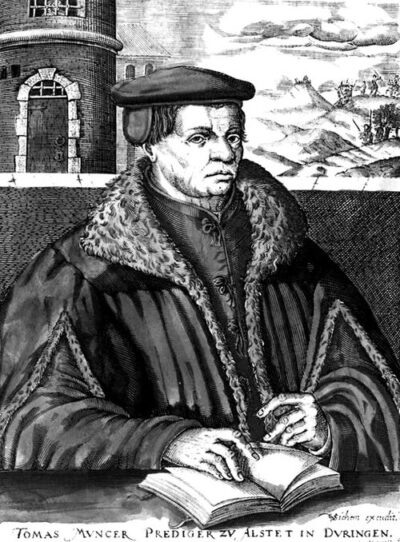
Thomas Müntzer
Thomas Müntzer was an early Reformation-era German pastor who was a rebel leader during the German Peasants' War. Born 1489, in Stolberg (Harz). Died May 27, 1525, in Mühlhausen/Thuringia. Educated at Leipzig University and University of Frankfurt an der Oder.
Facts
19 facts · 2 confirmed by two sources · 8 cited · 9 from one source
Where this comes from
Papalocal keeps its own record. It started from these sources; what each one said is kept here as it was copied, so a change on their side never changes this page by itself. Tap one to read its version.
What Wikidata says · copied November 16, 2026 · revision 2568259300
- Described as
- early Reformation-era German pastor who was a rebel leader during the German Peasants' War
- Other names
- Thomas Münzer
- Born
- 1489 · 5 references
- Died
- May 27, 1525 · 2 references
- Born in
- Stolberg (Harz) · 2 references
- Died in
- Mühlhausen/Thuringia · 1 reference
- Cause of death
- decapitation · 1 reference
- Citizen of
- Holy Roman Empire
- Occupation
- priest; revolutionary; theologian · 1 reference; Protestant reformer · 1 reference; lyricist; printer · 1 reference; parson · 1 reference; Protestant theologian · 1 reference
- Education
- Leipzig University (1506–); University of Frankfurt an der Oder (1512–)
- Spouse
- Ottilie Müntzer · 1 reference
- Religion
- Christian mysticism
- Website
- http://www.thomas-muentzer.de/
- Wikipedias with a page
- 60
Wikidata item Q153981 (wikidata.org/wiki/Q153981), public domain (CC0). Copied November 16, 2026.
What Wikipedia says · copied November 16, 2026 · revision 1382250165
Thomas Müntzer (c. 1489 – 27 May 1525) was a German preacher and theologian of the early Reformation whose opposition to both Martin Luther and the Catholic Church led to his open defiance of late-feudal authority in central Germany. Müntzer was foremost amongst those reformers who took issue with Luther's compromises with feudal authority. He was a leader of the German peasant and plebeian uprising of 1525 commonly known as the German Peasants' War.
In 1514, Müntzer became a Catholic priest in Brunswick, where he began to question the teachings and practices of the Catholic Church. He then became a follower and acquaintance of Martin Luther, who recommended him for a post in Zwickau. His beliefs became increasingly spiritual and apocalyptic; by his arrival at Allstedt in 1523 he had completely broken with Luther. Amidst the peasant uprisings in 1525, Müntzer organized an armed militia in Mühlhausen. He was captured after the Battle of Frankenhausen, tortured and finally executed.
Few other figures of the German Reformation raised as much controversy as Müntzer, which continues to this day. A complex and unusual character, he is now regarded as a significant personality in the early years of the German Reformation and the history of European revolutionaries. Almost all modern studies stress the necessity of understanding his revolutionary actions as a consequence of his theology: Müntzer believed that the end of the world was imminent and that it was the task of the true believers to aid God in ushering in a new era of history.
- Born, in its opening lines
- c. 1489
- Died, in its opening lines
- May 27, 1525
From the Wikipedia article “Thomas Müntzer” (en.wikipedia.org/wiki/Thomas_Müntzer), by its contributors, under CC BY-SA 4.0 (creativecommons.org/licenses/by-sa/4.0/). Copied November 16, 2026; not changed.
Confirmed Two sources agree. Cited One source, and it names where it got it. One source One source, without a reference of its own. Sources disagree The sources disagree. We show the best-supported value and keep theirs below.
