
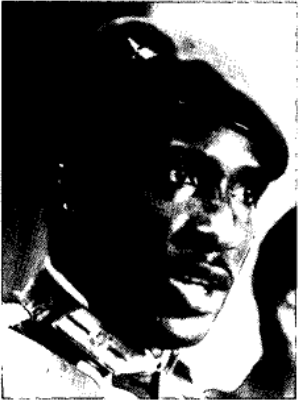
Thomas Sankara
Thomas Sankara was a President of Burkina Faso from 1983 to 1987. Born December 21, 1949, in Yako. Died October 15, 1987, in Ouagadougou. Positions held include president of Burkina Faso (1983–1987), Prime Minister of Burkina Faso (1983) and president. Known for Une Seule Nuit. Educated at Prytanée militaire de Kadiogo. Awards include Order of José Martí.
Facts
32 facts · 2 confirmed by two sources · 9 cited · 21 from one source
Where this comes from
Papalocal keeps its own record. It started from these sources; what each one said is kept here as it was copied, so a change on their side never changes this page by itself. Tap one to read its version.
What Wikidata says · copied November 16, 2026 · revision 2568444467
- Described as
- President of Burkina Faso from 1983 to 1987
- Other names
- Thomas Isidore Noël Sankara, Captain Thomas Sankara, Africa's Che Guevara
- Born
- December 21, 1949 · 7 references
- Died
- October 15, 1987 · 6 references
- Born in
- Yako · 2 references
- Died in
- Ouagadougou · 2 references
- Buried in
- Ouagadougou
- Cause of death
- gunshot wound
- Name at birth
- Thomas Isidore Noël Sankara
- Citizen of
- Republic of Upper Volta (1960–1984); Burkina Faso (1984–) · 1 reference
- Occupation
- politician · 3 references; military officer · 1 reference; statesperson; soldier · 1 reference; minister · 1 reference
- Positions held
- president of Burkina Faso (1983–1987); Prime Minister of Burkina Faso (1983); president · 1 reference
- Education
- Prytanée militaire de Kadiogo
- Instrument
- guitar
- Known for
- Une Seule Nuit
- Awards
- Order of José Martí (1984) · 3 references
- Field
- revolutionary · 1 reference; politician · 1 reference; poet · 1 reference; composer · 1 reference
- Spouse
- Mariam Sankara (–1987)
- Father
- Joseph Sambo Sankara
- Siblings
- Odile Sankara
- Religion
- Catholicism
- Military branch
- Army of Burkina Faso
- Military rank
- captain
- Website
- http://www.thomassankara.net
- Wikipedias with a page
- 98
Wikidata item Q202155 (wikidata.org/wiki/Q202155), public domain (CC0). Copied November 16, 2026.
What Wikipedia says · copied November 16, 2026 · revision 1385163680
Thomas Isidore Noël Sankara (21 December 1949 – 15 October 1987) was a Burkinabé military officer, politician, Marxist and pan-Africanist revolutionary who served as the first president of Burkina Faso from 1983 until his assassination in 1987. Sankara previously served as the fifth prime minister of Upper Volta from January to May 1983.
After Sankara was appointed Prime Minister of the Republic of Upper Volta in 1983, he disputed with the sitting government and was placed under house arrest, during which a group of revolutionaries seized power on his behalf in a popular coup later that year.
Following the coup, Sankara, then 33, became the President of the Republic of Upper Volta and launched an unprecedented series of social, ecological, and economic reforms that were part of what he referred to as the people's democratic revolution. In 1984, Sankara oversaw the renaming of the country as Burkina Faso ('land of the upright people'), and personally wrote its national anthem. His foreign policy centered on anti-imperialism and self-sufficiency, and he rejected loans and capital from such organizations as the International Monetary Fund. However, he welcomed some foreign aid in an effort to boost the domestic economy and diversify sources of assistance.
His domestic policies included famine prevention, agrarian expansion, land reform, and suspending rural poll taxes, as well as a nationwide literacy campaign and vaccination program to reduce meningitis, yellow fever and measles. Sankara's health programmes distributed millions of doses of vaccines to children across Burkina Faso. His government also focused on building schools, health centres, water reservoirs, and infrastructure projects. He combatted desertification of the Sahel by planting more than 10 million trees. Socially, his government enforced the prohibition of female circumcision, forced marriages, and polygamy. Sankara reinforced his populist image by ordering the sale of luxury vehicles and properties owned by the government in order to reduce costs, and refusing to use his office's air conditioning. He established Cuban-inspired Committees for the Defense of the Revolution purportedly to serve as a new foundation of society and promote popular mobilization. His Popular Revolutionary Tribunals prosecuted public officials charged with graft, political crimes and corruption, considering such elements of the state counter-revolutionaries. Amnesty International criticised his government for alleged human rights violations, such as arbitrary detentions of political opponents.
Sankara's revolutionary programmes and reforms for African self-reliance made him an icon to many of Africa's poverty-stricken nations, and the president remained popular with a substantial majority of his country's citizens, as well as those outside Burkina Faso. Some of his policies alienated elements of the former ruling class, including tribal leaders, and the governments of France and its ally, the Ivory Coast.
On 15 October 1987, Sankara was assassinated by troops led by Blaise Compaoré, who assumed leadership of the country shortly thereafter. Compaoré retained power until the 2014 Burkina Faso uprising. In 2021, he was formally charged by a military tribunal with the murder of Sankara and found guilty.
- Born, in its opening lines
- December 21, 1949
- Died, in its opening lines
- October 15, 1987
From the Wikipedia article “Thomas Sankara” (en.wikipedia.org/wiki/Thomas_Sankara), by its contributors, under CC BY-SA 4.0 (creativecommons.org/licenses/by-sa/4.0/). Copied November 16, 2026; not changed.
Confirmed Two sources agree. Cited One source, and it names where it got it. One source One source, without a reference of its own. Sources disagree The sources disagree. We show the best-supported value and keep theirs below.
