
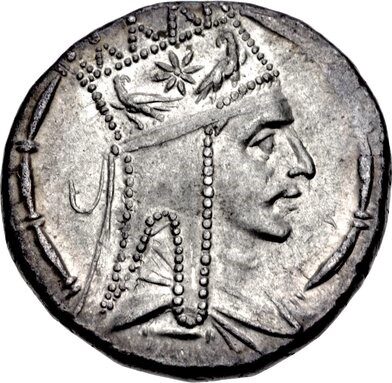
Tigranes the Great
Tigranes the Great was a king of Armenia. Born 140 BC, in Artaxata. Died 55 BC, in Kingdom of Armenia. Positions held include king of Armenia (-95–-55).
Facts
17 facts · 0 confirmed by two sources · 1 cited · 16 from one source
Where this comes from
Papalocal keeps its own record. It started from these sources; what each one said is kept here as it was copied, so a change on their side never changes this page by itself. Tap one to read its version.
What Wikidata says · copied November 16, 2026 · revision 2559085394
- Described as
- king of Armenia
- Other names
- Tigranes II
- Born
- 140 BC
- Died
- 55 BC · 1 reference
- Born in
- Artaxata
- Died in
- Kingdom of Armenia · 1 reference
- Buried in
- Tigranocerta
- Occupation
- sovereign
- Positions held
- king of Armenia (-95–-55)
- Spouse
- Cleopatra of Pontus
- Children
- Tigranes the Younger; Ariazate; wife of Mithridates I of Media Atropatene; sister of Artavasdes; Artavasdes II of Armenia
- Father
- Tigranes I
- Siblings
- Guras; Artavasdes of Armenia
- Religion
- Zoroastrianism
- Wikipedias with a page
- 73
Wikidata item Q201303 (wikidata.org/wiki/Q201303), public domain (CC0). Copied November 16, 2026.
What Wikipedia says · copied November 16, 2026 · revision 1385951504
Tigranes II, more commonly known as Tigranes the Great (Tigran Mets in Armenian; 140–55 BC), was a king of Armenia. A member of the Artaxiad dynasty, he ruled from 95 BC to 55 BC. Under his reign, the Armenian kingdom expanded beyond its traditional boundaries and reached its peak, allowing Tigranes to claim the title Great King or King of Kings. His empire for a short time was the most powerful state to the east of the Roman Republic.
Either the son or nephew of Artavasdes I, Tigranes was given as a hostage to Mithridates II of Parthia after Armenia came under Parthian suzerainty. However, ancient authors say nothing about the suzerainty of the Parthians over Armenia. After ascending to the Armenian throne, he rapidly expanded his kingdom by invading or annexing Roman and Parthian client-kingdoms. Tigran decided to ally with Mithridates VI of Pontus by marrying his daughter Cleopatra. At its height, Tigranes' empire stretched from the Pontic Alps to Mesopotamia and from the Caspian Sea to the Mediterranean. With captured vassals, his lands even reached the Red Sea and the Persian Gulf. Many of the inhabitants of conquered cities were forcibly relocated to his new capital, Tigranocerta. An admirer of the Greek culture, Tigranes invited many Greek rhetoricians and philosophers to his court, and his capital was noted for its Hellenistic architecture.
Armenia came into direct conflict with Rome after Mithridates VI was forced to seek refuge in Tigranes' court. In 69 BC, Tigranes was decisively defeated at the Battle of Tigranocerta by a Roman army under the command of Lucullus, and a year later he met another major defeat at Artaxata, the old Armenian capital. The recall of Lucullus gave Tigranes a brief respite, but in 66 BC Armenia faced another Roman invasion led by Pompey, aided by Tigranes' own son, Tigranes the Younger. Tigranes chose to surrender and was allowed to retain the heartland of his kingdom as a Roman buffer state, while all of his conquests were annexed. He continued to rule Armenia as a client-king of Rome until his death around 55 BC at the age of 85.
From the Wikipedia article “Tigranes the Great” (en.wikipedia.org/wiki/Tigranes_the_Great), by its contributors, under CC BY-SA 4.0 (creativecommons.org/licenses/by-sa/4.0/). Copied November 16, 2026; not changed.
Confirmed Two sources agree. Cited One source, and it names where it got it. One source One source, without a reference of its own. Sources disagree The sources disagree. We show the best-supported value and keep theirs below.
