
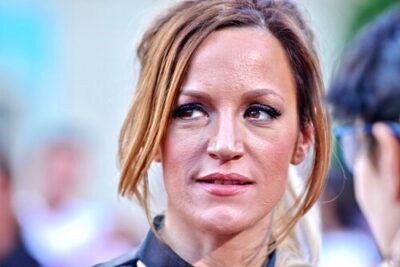
Tijana Bogićević is a Serbian singer. Born November 1, 1981, in Novi Sad.
Facts
7 facts · 1 confirmed by two sources · 0 cited · 6 from one source
Where this comes from
Papalocal keeps its own record. It started from these sources; what each one said is kept here as it was copied, so a change on their side never changes this page by itself. Tap one to read its version.
What Wikidata says · copied November 16, 2026 · revision 2543462963
- Described as
- Serbian singer
- Born
- November 1, 1981 · 1 reference
- Born in
- Novi Sad
- Citizen of
- Serbia
- Occupation
- singer
- Genre
- pop music · 1 reference
- Instrument
- voice
- Website
- https://tijanabogicevic.com/
- Wikipedias with a page
- 28
Wikidata item Q28849470 (wikidata.org/wiki/Q28849470), public domain (CC0). Copied November 16, 2026.
What Wikipedia says · copied November 16, 2026 · revision 1371009859
Tijana Bogićević (Serbian Cyrillic: Тијана Богићевић, pronounced [tǐjana boɡǐːt͡ɕeʋit͡ɕ]; born 1 November 1981) is a Serbian singer. She represented Serbia in the Eurovision Song Contest 2017 with the song "In Too Deep" but failed to qualify to the final. Bogićević was previously a backing vocalist for Nina at the Eurovision Song Contest 2011. She also competed to represent Serbia in the Eurovision Song Contest 2009 through Beovizija 2009, but did not advance past the semi-final.
Bogićević first achieved major recognition in Serbia in 2013, after the release of her single "Čudo". The following year she released a duet with Aleksa Jelić, "Još jednom". Bogićević currently resides in the United States. She married Mark Robertson, the lead singer of the band Queen Of Hearts, in 2015. but they divorced in 2022.
- Born, in its opening lines
- November 1, 1981
From the Wikipedia article “Tijana Bogićević” (en.wikipedia.org/wiki/Tijana_Bogićević), by its contributors, under CC BY-SA 4.0 (creativecommons.org/licenses/by-sa/4.0/). Copied November 16, 2026; not changed.
Confirmed Two sources agree. Cited One source, and it names where it got it. One source One source, without a reference of its own. Sources disagree The sources disagree. We show the best-supported value and keep theirs below.
