
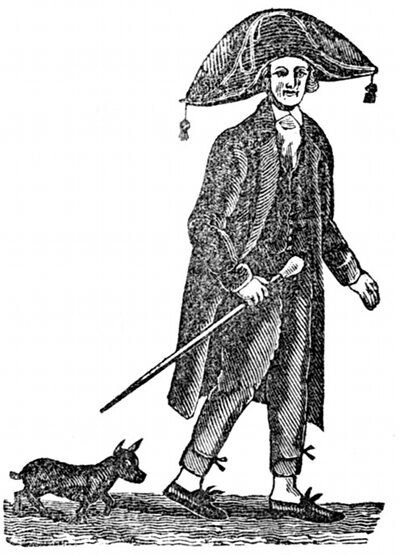
Timothy Dexter
Timothy Dexter was an American businessman and author. Born January 22, 1747, in Malden. Died October 23, 1806, in Newburyport.
Facts
8 facts · 2 confirmed by two sources · 3 cited · 3 from one source
What’s different
- Born: we show January 22, 1747 (Confirmed). Wikidata also lists February 22, 1747
Where this comes from
Papalocal keeps its own record. It started from these sources; what each one said is kept here as it was copied, so a change on their side never changes this page by itself. Tap one to read its version.
What Wikidata says · copied November 16, 2026 · revision 2567864013
- Described as
- American businessman and author (1747–1806)
- Born
- January 22, 1747; February 22, 1747 · 1 reference
- Died
- October 23, 1806 · 1 reference
- Born in
- Malden · 1 reference
- Died in
- Newburyport · 1 reference
- Buried in
- Old Burial Hill
- Citizen of
- United States
- Occupation
- merchant; businessperson · 1 reference
- Wikipedias with a page
- 23
Wikidata item Q598210 (wikidata.org/wiki/Q598210), public domain (CC0). Copied November 16, 2026.
What Wikipedia says · copied November 16, 2026 · revision 1385724289
Timothy Dexter (January 22, 1747 – October 23, 1806), self-styled Lord Timothy Dexter, was an American businessman noted for his eccentric behavior and writings. He became wealthy through marriage and a series of improbably successful investments and spent his fortune lavishly. Though barely educated or literate, Dexter considered himself "the greatest philosopher in the known world", and authored a book, A Pickle for the Knowing Ones, which espouses his views on a variety of topics and is notorious for its unusual misspellings and grammatical errors.
- Born, in its opening lines
- January 22, 1747
- Died, in its opening lines
- October 23, 1806
From the Wikipedia article “Timothy Dexter” (en.wikipedia.org/wiki/Timothy_Dexter), by its contributors, under CC BY-SA 4.0 (creativecommons.org/licenses/by-sa/4.0/). Copied November 16, 2026; not changed.
Confirmed Two sources agree. Cited One source, and it names where it got it. One source One source, without a reference of its own. Sources disagree The sources disagree. We show the best-supported value and keep theirs below.
