
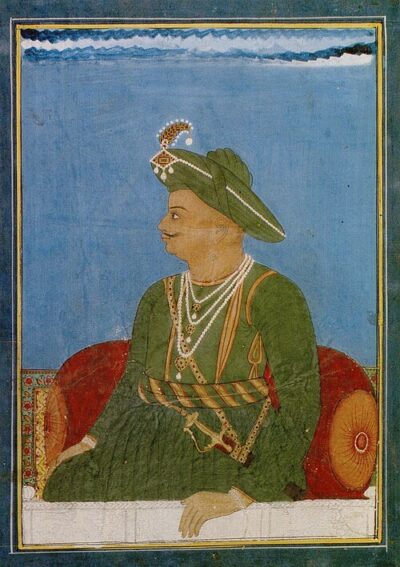
Tipu Sultan
Tipu Sultan was a Ruler of the Kingdom of Mysore from 1782 to 1799. Born December 1, 1751, in Devanahalli. Died May 4, 1799, in Srirangapatna. Positions held include monarch and sultan of Mysore (1782–1799).
Facts
25 facts · 2 confirmed by two sources · 1 cited · 22 from one source
What’s different
- Born: we show December 1, 1751 (Confirmed). Wikidata also lists November 20, 1751
Where this comes from
Papalocal keeps its own record. It started from these sources; what each one said is kept here as it was copied, so a change on their side never changes this page by itself. Tap one to read its version.
What Wikidata says · copied November 16, 2026 · revision 2564627532
- Described as
- Ruler of the Kingdom of Mysore from 1782 to 1799
- Other names
- Tippoo Sahib, Sultan Fateh Ali Sahab Tipu, Tipu Sahab, Tippoo Saib, Sher e Mysore, Tippoo Sultan
- Born
- November 20, 1751 · 1 reference; December 1, 1751 · 1 reference
- Died
- May 4, 1799 · 4 references
- Born in
- Devanahalli · 1 reference
- Died in
- Srirangapatna · 1 reference
- Buried in
- Srirangapatna · 1 reference
- Citizen of
- Kingdom of Mysore
- Occupation
- politician · 1 reference; writer · 1 reference; ruler; freedom fighter
- Positions held
- monarch; sultan of Mysore (1782–1799)
- Children
- Shezada Hyder Ali; Ghulam Muhammad Sultan Sahib; Abdul Khaliq Sultan; Fateh Hyder; Muiz-ud-din; Yasin Sahib; Subhan Sahib; Shukr-ullah; Ghulam Ahmad
- Father
- Hyder Ali
- Religion
- Islam
- Military rank
- general
- Lived in
- Karnataka
- Wikipedias with a page
- 65
Wikidata item Q10088 (wikidata.org/wiki/Q10088), public domain (CC0). Copied November 16, 2026.
What Wikipedia says · copied November 16, 2026 · revision 1379806571
Tipu Sultan (Urdu: [ʈiːpuː sʊlt̪aːn], Kannada: [ʈipːu sult̪aːn], Sultan Fateh Ali Sahab Tipu; 1 December 1751 – 4 May 1799), commonly referred to as Sher-e-Mysore (Tiger of Mysore), was the Sultan of Mysore from 1782 until his death in 1799. He was a pioneer of rocket artillery. He expanded the iron-cased Mysorean rockets and commissioned the military manual Fathul Mujahidin. The economy of Mysore reached a zenith during his reign. He deployed rockets against advances of British forces and their allies during the Anglo-Mysore Wars, including the Battle of Pollilur and Siege of Srirangapatna.
Tipu Sultan and his father Hyder Ali used their French-trained army in alliance with the French in their struggle with the British, and in Mysore's struggles with other surrounding powers: against the Marathas, Sira, and rulers of Malabar, Kodagu, Bednore, Carnatic, and Travancore. Tipu became the ruler of Mysore upon his father's death from cancer in 1782 during the Second Anglo-Mysore War. He negotiated with the British in 1784 with the Treaty of Mangalore which ended the war in status quo ante bellum.
Tipu's conflicts with his neighbours included the Maratha–Mysore War, which ended with the signing of the Treaty of Gajendragad.
Tipu remained an enemy of the British East India Company. He initiated an attack on British-allied Travancore in 1789. In the Third Anglo-Mysore War, he was forced into the Treaty of Seringapatam, losing a number of previously conquered territories, including Malabar and Mangalore. In the Fourth Anglo-Mysore War, a combined force of British East India Company troops supported by the Marathas and the Nizam of Hyderabad defeated Tipu. He was killed on 4 May 1799 while defending his stronghold of Seringapatam.
Tipu also introduced administrative innovations during his rule, including a new coinage system and calendar, and a new land revenue system, which initiated the growth of the Mysore silk industry. He is known for his patronage to Channapatna toys.
- Born, in its opening lines
- December 1, 1751
- Died, in its opening lines
- May 4, 1799
From the Wikipedia article “Tipu Sultan” (en.wikipedia.org/wiki/Tipu_Sultan), by its contributors, under CC BY-SA 4.0 (creativecommons.org/licenses/by-sa/4.0/). Copied November 16, 2026; not changed.
Confirmed Two sources agree. Cited One source, and it names where it got it. One source One source, without a reference of its own. Sources disagree The sources disagree. We show the best-supported value and keep theirs below.
