
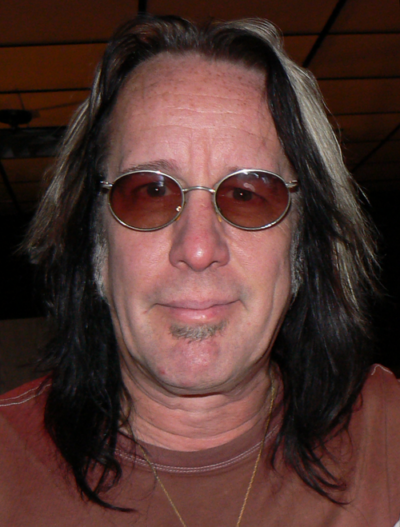
Todd Rundgren
Todd Rundgren is an American musician, songwriter, and record producer. Born June 22, 1948, in Upper Darby Township. Educated at Upper Darby High School. Awards include Rock and Roll Hall of Fame.
Facts
35 facts · 1 confirmed by two sources · 8 cited · 26 from one source
Where this comes from
Papalocal keeps its own record. It started from these sources; what each one said is kept here as it was copied, so a change on their side never changes this page by itself. Tap one to read its version.
What Wikidata says · copied November 15, 2026 · revision 2565613942
- Described as
- American musician, songwriter, and record producer
- Other names
- Runt, Todd Harry Rundgren
- Born
- June 22, 1948 · 3 references
- Born in
- Upper Darby Township
- Citizen of
- United States
- Occupation
- singer · 1 reference; singer-songwriter; guitarist · 1 reference; composer · 1 reference; record producer; pianist; poet; director
- Education
- Upper Darby High School · 1 reference
- Member of
- Nazz; Utopia · 1 reference
- Genre
- rock and roll; soul; progressive rock; pop rock; hard rock; blue-eyed soul
- Instrument
- guitar · 1 reference; piano; bass guitar; keyboard instrument; percussion instrument; saxophone
- Record label
- Bearsville Records
- Awards
- Rock and Roll Hall of Fame (2021) · 1 reference
- Spouse
- Michele Gray (1998–) · 1 reference
- Children
- Liv Tyler · 1 reference; Rex Rundgren; Randy Rundgren; Rebop Rundgren; Keoni K. Watson · 1 reference
- Website
- http://www.tr-i.com
- Wikipedias with a page
- 27
Wikidata item Q364875 (wikidata.org/wiki/Q364875), public domain (CC0). Copied November 15, 2026.
What Wikipedia says · copied November 15, 2026 · revision 1378080418
Todd Harry Rundgren (born June 22, 1948) is an American musician, singer, songwriter, and record producer who has performed a diverse range of styles as a solo artist and as a member of the bands Nazz and Utopia. He is known for his sophisticated and often unorthodox music, his occasionally lavish stage shows, and his later experiments with interactive art. He also produced music videos and was an early adopter and promoter of various computer technologies, such as using the Internet as a means of music distribution in the late 1990s.
A native of Upper Darby, Pennsylvania, Rundgren began his professional career in the mid-1960s, forming the psychedelic band Nazz in 1967. After two years, he left Nazz to pursue a solo career and immediately scored his first US top 40 hit with "We Gotta Get You a Woman" (1970). His best-known songs include "Hello It's Me" and "I Saw the Light" from Something/Anything? (1972), which get frequent air time on classic rock radio stations, the 1978 "Can We Still Be Friends", and the 1983 single "Bang the Drum All Day", which is featured in many sports arenas, commercials, and movie trailers. Although lesser known, "Couldn't I Just Tell You" (1972) was influential to many artists in the power pop genre. His 1973 album A Wizard, a True Star remains an influence on later generations of bedroom musicians.
Rundgren is considered a pioneer in the fields of electronic music, progressive rock, music videos, computer software, and Internet music delivery. He organized the first interactive television concert in 1978, designed the first color graphics tablet in 1980, and created the first interactive album, No World Order, in 1993.
Additionally, he was one of the first acts to be prominent as both an artist and producer. His notable production credits include Badfinger's Straight Up (1971), Grand Funk Railroad's We're an American Band (1973), the New York Dolls' New York Dolls (1973), Meat Loaf's Bat Out of Hell (1977), and XTC's Skylarking (1986). He was inducted into the Rock and Roll Hall of Fame in 2021.
- Born, in its opening lines
- June 22, 1948
From the Wikipedia article “Todd Rundgren” (en.wikipedia.org/wiki/Todd_Rundgren), by its contributors, under CC BY-SA 4.0 (creativecommons.org/licenses/by-sa/4.0/). Copied November 15, 2026; not changed.
Confirmed Two sources agree. Cited One source, and it names where it got it. One source One source, without a reference of its own. Sources disagree The sources disagree. We show the best-supported value and keep theirs below.
