
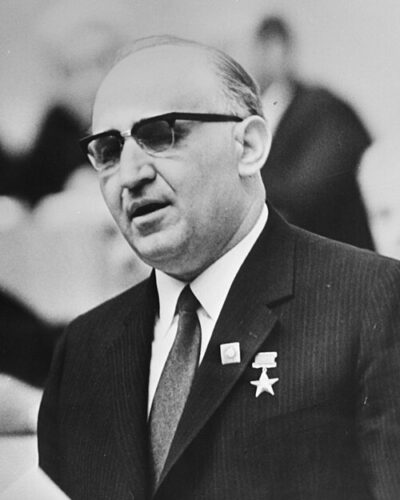
Todor Zhivkov
Todor Zhivkov was a former General Secretary of the Bulgarian Communist Party. Born September 7, 1911, in Pravets. Died August 5, 1998, in Sofia. Positions held include Chairman of the Council of Ministers of the People's Republic of Bulgaria (1962–1971), Chairman (President) of Bulgaria (1971–1989) and member of the Bulgarian National Assembly. Awards include Order of José Martí, Hero of the Soviet Union and Order of the October Revolution.
Facts
38 facts · 2 confirmed by two sources · 7 cited · 29 from one source
Where this comes from
Papalocal keeps its own record. It started from these sources; what each one said is kept here as it was copied, so a change on their side never changes this page by itself. Tap one to read its version.
What Wikidata says · copied November 16, 2026 · revision 2569113132
- Described as
- former General Secretary of the Bulgarian Communist Party
- Other names
- Todor Hristov Zhivkov
- Born
- September 7, 1911 · 11 references
- Died
- August 5, 1998 · 10 references
- Born in
- Pravets
- Died in
- Sofia · 2 references
- Buried in
- Central Sofia Cemetery · 1 reference
- Cause of death
- pneumonia
- Citizen of
- Bulgaria; People's Republic of Bulgaria; Kingdom of Bulgaria
- Occupation
- politician · 1 reference; statesperson; resistance fighter
- Positions held
- Chairman of the Council of Ministers of the People's Republic of Bulgaria (1962–1971); Chairman (President) of Bulgaria (1971–1989); member of the Bulgarian National Assembly; Mayor of Sofia Capital Municipality (1949)
- Political party
- Bulgarian Communist Party
- Awards
- Order of José Martí; Hero of the Soviet Union (1977); Order of the October Revolution; Order of Klement Gottwald; Hero of Socialist Labour of Bulgaria (1961); Order of Georgi Dimitrov (4 times) (1961, 1971, 1981, 1986) · 1 reference; Order of Sukhbaatar; Gold Olympic Order (1987) · 1 reference; Order of the Yugoslavian Great Star; Grand Collar of the Order of Prince Henry · 1 reference; Order of Playa Girón; Order of the Republic; Jubilee Medal "Forty Years of Victory in the Great Patriotic War 1941–1945" · 1 reference; Order of Karl Marx · 1 reference; Order of Prince Henry · 1 reference
- Field
- politician; politics · 1 reference
- Spouse
- Mara Maleeva-Zhivkova
- Children
- Lyudmila Zhivkova · 1 reference; Vladimir Zhivkov
- Religion
- atheism
- Wikipedias with a page
- 71
Wikidata item Q28517 (wikidata.org/wiki/Q28517), public domain (CC0). Copied November 16, 2026.
What Wikipedia says · copied November 16, 2026 · revision 1385559804
Todor Hristov Zhivkov (Bulgarian: Тодор Христов Живков [ˈtɔdor ˈxristof ˈʒifkof]; 7 September 1911 – 5 August 1998) was a Bulgarian communist politician who served as the de facto leader of the People's Republic of Bulgaria (PRB) from 1956 until 1989 as General Secretary of the Central Committee of the Bulgarian Communist Party. He was the longest-serving leader in the Eastern Bloc, the longest-serving leader within the Warsaw Pact and the longest-serving non-royal ruler in Bulgarian history.
During World War II, Zhivkov participated in Bulgaria's resistance movement in the People's Liberation Insurgent Army. In 1943, he was involved in organising the Chavdar Partisan Brigade in and around his place of birth, becoming deputy commander of the Sofia operations area in the summer of 1944. Under his rule, many fellow former combatants with Chavdar were to rise to positions of prominence in Bulgarian affairs. He is said to have coordinated partisan movements with those of pro-Soviet army units during the 9 September 1944 uprising.
He became First Secretary of the Bulgarian Communist Party (BCP) in 1954 (General Secretary from April 1981), served as Prime Minister from 1962 to 1971 and from 1971 onwards as Chairman of the State Council, concurrently with his post as First Secretary. He remained in these positions for 35 years, until 1989, thus becoming the longest-serving leader of any European Eastern Bloc nation after World War II, and one of the longest ruling non-royal leaders in modern history. His rule marked a period of unprecedented political and economic stability for Bulgaria, marked both by complete submission of Bulgaria to the Soviet Union and a desire to expand ties with the West. Bulgaria placed paramount importance on scientific and technological progress, as well as on the cultivation of trade skills suited to an industrial economy. In 1948, roughly 80 percent of the population depended on agriculture for their livelihood; by 1988, however, fewer than one in five workers remained in the agricultural sector, with the rest concentrated in industry and services. Zhivkov's government maintained a tight policy against minority groups throughout his tenure; most notably, from 1984 onward, tightened internal policies led to the Revival Process against Bulgarian Turks, a policy of forced assimilation which led to a large-scale expulsion of Turks and Muslims in 1989.
Zhivkov's rule remained unchallenged until the deterioration of East–West relations in the 1980s, when a stagnating economic situation, a worsening international image and growing careerism and corruption in the BCP weakened his position. He resigned on 10 November 1989, under pressure by senior BCP members due to his refusal to recognise problems and deal with public protests. Within a month of Zhivkov's ousting, communist rule in Bulgaria had effectively ended, and within a year the People's Republic of Bulgaria had formally ceased to exist.
- Born, in its opening lines
- September 7, 1911
- Died, in its opening lines
- August 5, 1998
From the Wikipedia article “Todor Zhivkov” (en.wikipedia.org/wiki/Todor_Zhivkov), by its contributors, under CC BY-SA 4.0 (creativecommons.org/licenses/by-sa/4.0/). Copied November 16, 2026; not changed.
Confirmed Two sources agree. Cited One source, and it names where it got it. One source One source, without a reference of its own. Sources disagree The sources disagree. We show the best-supported value and keep theirs below.
