
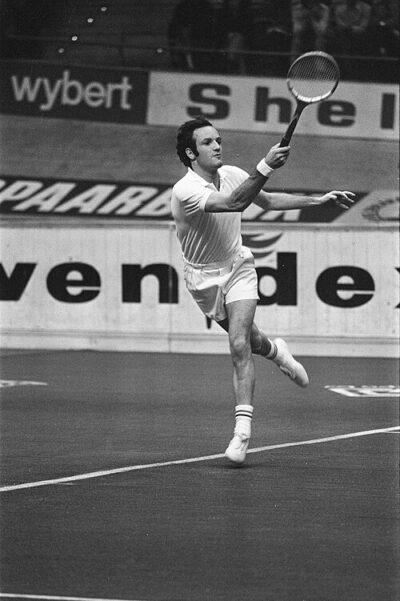
Tom Okker is a Dutch tennis player. Born February 22, 1944, in Amsterdam. Teams include Netherlands Davis Cup team.
Facts
11 facts · 1 confirmed by two sources · 7 cited · 3 from one source
Where this comes from
Papalocal keeps its own record. It started from these sources; what each one said is kept here as it was copied, so a change on their side never changes this page by itself. Tap one to read its version.
What Wikidata says · copied November 17, 2026 · revision 2562546575
- Described as
- Dutch tennis player
- Other names
- Thomas Samuel Okker
- Born
- February 22, 1944 · 2 references
- Born in
- Amsterdam · 1 reference
- Name at birth
- Tom Samuel Okker
- Citizen of
- Kingdom of the Netherlands · 1 reference
- Occupation
- tennis player (1968–1981) · 1 reference; art collector · 1 reference; gallerist · 2 references
- Teams
- Netherlands Davis Cup team · 1 reference
- Sport
- tennis · 1 reference
- Lived in
- Hazerswoude-Dorp
- Height
- 1.77 m (5 ft 10 in)
- Wikipedias with a page
- 26
Wikidata item Q455411 (wikidata.org/wiki/Q455411), public domain (CC0). Copied November 17, 2026.
What Wikipedia says · copied November 17, 2026 · revision 1381965217
Thomas Samuel Okker (born 22 February 1944), nicknamed "the Flying Dutchman", is a Dutch former tennis player who was active from the mid-1960s until 1980. He won the 1973 French Open Doubles, the 1976 US Open Doubles, and two gold medals at the 1965 Maccabiah Games in Israel. He was ranked among the world's top-ten singles players for seven consecutive years, 1968–74, reaching a career high of world No. 3 in 1974. He also was ranked world No. 1 in doubles in 1979.
- Born, in its opening lines
- February 22, 1944
From the Wikipedia article “Tom Okker” (en.wikipedia.org/wiki/Tom_Okker), by its contributors, under CC BY-SA 4.0 (creativecommons.org/licenses/by-sa/4.0/). Copied November 17, 2026; not changed.
Confirmed Two sources agree. Cited One source, and it names where it got it. One source One source, without a reference of its own. Sources disagree The sources disagree. We show the best-supported value and keep theirs below.
