
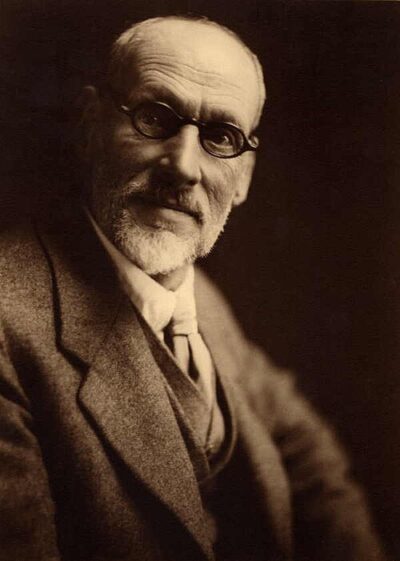
Tom Roberts
Tom Roberts was an Australian artist. Born March 9, 1856, in Dorchester. Died September 14, 1931, in Kallista. Known for A break away!, Bailed Up and Bourke Street. Educated at National Gallery of Victoria Art School and The Thomas Hardye School.
Facts
17 facts · 1 confirmed by two sources · 1 cited · 14 from one source · 1 where the sources disagree
What’s different
- Born: we show March 9, 1856 (Sources disagree). Wikipedia says March 8, 1856
Where this comes from
Papalocal keeps its own record. It started from these sources; what each one said is kept here as it was copied, so a change on their side never changes this page by itself. Tap one to read its version.
What Wikidata says · copied November 18, 2026 · revision 2569659987
- Described as
- Australian artist (1856-1931)
- Other names
- Tom. Roberts, Tom William Roberts, Thomas Roberts, Thomas William Roberts
- Born
- March 9, 1856 · 6 references
- Died
- September 14, 1931 · 6 references
- Born in
- Dorchester
- Died in
- Kallista
- Cause of death
- cancer
- Name at birth
- Thomas William Roberts
- Citizen of
- Australia
- Occupation
- painter
- Education
- National Gallery of Victoria Art School; The Thomas Hardye School
- Genre
- portrait
- Known for
- A break away!; Bailed Up; Bourke Street; The Big Picture; Shearing the Rams
- Spouse
- Lillie Williamson (1896–1928) · 1 reference
- Wikipedias with a page
- 23
Wikidata item Q1291901 (wikidata.org/wiki/Q1291901), public domain (CC0). Copied November 18, 2026.
What Wikipedia says · copied November 18, 2026 · revision 1385792761
Thomas William Roberts (8 March 1856 – 14 September 1931) was an English-born Australian artist and a key member of the Heidelberg School art movement, also known as Australian impressionism.
After studying in Melbourne, he travelled to Europe in 1881 to further his training, and returned home in 1885, "primed with whatever was the latest in art". That year, he joined Frederick McCubbin in founding the Box Hill artists' camp, the first of several plein air camps frequented by members of the Heidelberg School. Together with Arthur Streeton and Charles Conder, they staged the 1889 9 by 5 Impression Exhibition, Australia's first self-consciously avant-garde art exhibition.
Nicknamed "Bulldog" due to his tenacity and drive, Roberts was considered the primary force behind the Heidelberg School movement. He encouraged other artists to capture the national life of Australia, and while he is best known today for his "national narratives"—among them Shearing the Rams (1890), A break away! (1891) and Bailed Up (1895)—he earned a living as a society portraitist, and was the first person to push for Australia to have its own National Portrait Gallery. In 1903, he completed the commissioned work The Big Picture, the most famous visual representation of the first Australian Parliament.
- Born, in its opening lines
- March 8, 1856
- Died, in its opening lines
- September 14, 1931
From the Wikipedia article “Tom Roberts” (en.wikipedia.org/wiki/Tom_Roberts), by its contributors, under CC BY-SA 4.0 (creativecommons.org/licenses/by-sa/4.0/). Copied November 18, 2026; not changed.
Confirmed Two sources agree. Cited One source, and it names where it got it. One source One source, without a reference of its own. Sources disagree The sources disagree. We show the best-supported value and keep theirs below.
