
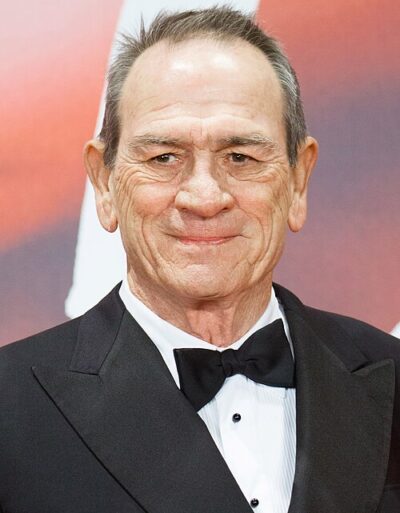
Tommy Lee Jones
Tommy Lee Jones is an American actor and film director. Born September 15, 1946, in San Saba. Teams include Harvard Crimson football. Educated at Harvard University and Harvard College. Awards include Donostia Award, Academy Award for Best Supporting Actor and Primetime Emmy Award for Outstanding Lead Actor in a Miniseries or a Movie.
Facts
31 facts · 1 confirmed by two sources · 8 cited · 22 from one source
Where this comes from
Papalocal keeps its own record. It started from these sources; what each one said is kept here as it was copied, so a change on their side never changes this page by itself. Tap one to read its version.
What Wikidata says · copied November 13, 2026 · revision 2558260632
- Described as
- American actor and film director (born 1946)
- Other names
- Thomas Lee Jones, Tom Lee Jones
- Born
- September 15, 1946 · 11 references
- Born in
- San Saba · 2 references
- Citizen of
- United States
- Occupation
- film actor · 1 reference; film director; film producer; polo player; voice actor; screenwriter; stage actor; television actor
- Education
- Harvard University; Harvard College; St. Mark's School of Texas · 1 reference; Robert E. Lee High School · 1 reference
- Member of
- Writers Guild of America West
- Teams
- Harvard Crimson football
- Sport
- polo
- Genre
- Western
- Awards
- Donostia Award (2012); Academy Award for Best Supporting Actor (1994) · 1 reference; Primetime Emmy Award for Outstanding Lead Actor in a Miniseries or a Movie (1983); star on Hollywood Walk of Fame · 1 reference; Cannes Best Director Award (2005) · 1 reference; Golden Globe Award for Best Supporting Actor – Motion Picture (1994) · 1 reference
- Spouse
- Kate Lardner (1971–1978) · 1 reference; Kimberlea Cloughley (1981–1996) · 2 references; Dawn Laurel (2001–) · 1 reference
- Children
- Victoria Jones; Austin Leonard Jones
- Lived in
- Terrell Hills
- Wikipedias with a page
- 82
Wikidata item Q170587 (wikidata.org/wiki/Q170587), public domain (CC0). Copied November 13, 2026.
What Wikipedia says · copied November 13, 2026 · revision 1383817236
Thomas Lee Jones (born September 15, 1946) is an American actor, film director, and former football player. He has received various accolades including an Academy Award, a Golden Globe Award, a Primetime Emmy Award, and two Screen Actors Guild Awards.
After appearing in several projects from the 1960s to 1980s, Jones established himself as a leading man in the 1990s, known for his gruff and authoritative film roles. He won the Academy Award for Best Supporting Actor for his performance as U.S. Marshal Samuel Gerard in the thriller film The Fugitive (1993). His other Oscar-nominated roles were as businessman Clay Shaw in JFK (1991), Hank Deerfield in In the Valley of Elah (2007), and Congressman Thaddeus Stevens in Lincoln (2012). He played Agent K in the Men in Black franchise. Other notable roles were in Coal Miner's Daughter (1980), Volcano (1997), Under Siege (1992), Natural Born Killers (1994), The Client (1994), Batman Forever (1995), Double Jeopardy (1999), No Country for Old Men (2007), The Company Men (2010), Captain America: The First Avenger (2011), Jason Bourne (2016) and Ad Astra (2019).
Jones won the Primetime Emmy Award for Outstanding Lead Actor in a Limited Series or Movie for his role as executed murderer Gary Gilmore in The Executioner's Song (1982). He was further nominated for playing Texas Ranger Woodrow F. Call in the television miniseries Lonesome Dove (1989). He portrayed Howard Hughes in the CBS film The Amazing Howard Hughes (1977). He directed and starred in the western TNT movie The Good Old Boys (1995). He directed, starred in, and executive produced the HBO film The Sunset Limited (2011).
- Born, in its opening lines
- September 15, 1946
From the Wikipedia article “Tommy Lee Jones” (en.wikipedia.org/wiki/Tommy_Lee_Jones), by its contributors, under CC BY-SA 4.0 (creativecommons.org/licenses/by-sa/4.0/). Copied November 13, 2026; not changed.
Confirmed Two sources agree. Cited One source, and it names where it got it. One source One source, without a reference of its own. Sources disagree The sources disagree. We show the best-supported value and keep theirs below.
