
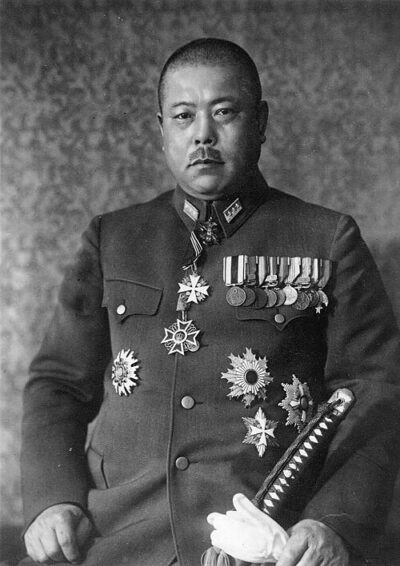
Tomoyuki Yamashita
Tomoyuki Yamashita was a prominent general in the Imperial Japanese Army. He gained renown for his swift military campaigns during World War II, particularly the invasion of Malaya and the subsequent capture of Singapore. This rapid conquest, achieved in just seventy days, earned him the nickname "The Tiger of Malaya." Later in the war, Yamashita was tasked with defending the Philippines against the Allied advance. Despite facing overwhelming odds, limited resources, and ongoing guerrilla resistance, his forces managed to maintain control over a portion of Luzon until Japan's official surrender in August 1945. He was born in 1885 and died in 1946.
Facts
21 facts · 2 confirmed by two sources · 0 cited · 19 from one source
Where this comes from
Papalocal keeps its own record. It started from these sources; what each one said is kept here as it was copied, so a change on their side never changes this page by itself. Tap one to read its version.
What Wikidata says · copied November 13, 2026 · revision 2557089340
- Described as
- Japanese general and war criminal (1885–1946)
- Other names
- Yamashita Tomoyuki
- Born
- November 8, 1885 · 6 references
- Died
- February 23, 1946 · 6 references
- Born in
- Akatsuka
- Died in
- Los Baños
- Buried in
- Tama Cemetery · 1 reference
- Cause of death
- hanging to death
- Citizen of
- Japan
- Occupation
- military officer
- Positions held
- Governor-General of the Philippines (1944–1945)
- Education
- Army War College; Imperial Japanese Army Academy; Central Military Preparatory School; Hiroshima Military Preparatory School
- Awards
- Order of the Rising Sun, 1st class; Order of the Golden Kite; Order of the Crown of Romania; Decoration of Honour for Services to the Republic of Austria; Inter-Allied Victory Medals · 1 reference
- Siblings
- Tomoyoshi Yamashita
- Military branch
- Imperial Japanese Army · 1 reference
- Military rank
- general
- Wikipedias with a page
- 43
Wikidata item Q254004 (wikidata.org/wiki/Q254004), public domain (CC0). Copied November 13, 2026.
What Wikipedia says · copied November 13, 2026 · revision 1383301718
Tomoyuki Yamashita (山下 奉文, Yamashita Tomoyuki; 8 November 1885 – 23 February 1946; also called Tomobumi Yamashita) was a general in the Imperial Japanese Army during World War II. Yamashita led Japanese forces during the invasion of Malaya and Battle of Singapore. His conquest of Malaya and Singapore in 70 days earned him the sobriquet "The Tiger of Malaya". He was assigned to defend the Philippines from the advancing Allies later in the war. Although he was unable to prevent the superior Allied forces from advancing, despite dwindling supplies and Allied guerrilla action, he was able to hold on to part of Luzon until after the formal surrender of Japan in August 1945.
Under Yamashita's command, at least 350,000 to 450,000 were killed. Yamashita was in overall command during the Sook Ching massacre, the Rape of Manila, and other atrocities. After the war, Yamashita was tried for war crimes committed by troops under his command during the Japanese defense of the occupied Philippines in 1944. Yamashita denied ordering those war crimes and said that he did not have knowledge that they occurred. Conflicting evidence was presented during the trial concerning whether Yamashita had implicitly affirmed commission of these crimes in his orders and whether he knew of the crimes being committed. The court eventually found Yamashita guilty and he was executed in February, 1946. The ruling against Yamashita – holding the commander responsible for subordinates' war crimes as long as the commander did not attempt to discover and stop them from occurring – came to be known as the Yamashita standard.
- Born, in its opening lines
- November 8, 1885
- Died, in its opening lines
- February 23, 1946
From the Wikipedia article “Tomoyuki Yamashita” (en.wikipedia.org/wiki/Tomoyuki_Yamashita), by its contributors, under CC BY-SA 4.0 (creativecommons.org/licenses/by-sa/4.0/). Copied November 13, 2026; not changed.
Confirmed Two sources agree. Cited One source, and it names where it got it. One source One source, without a reference of its own. Sources disagree The sources disagree. We show the best-supported value and keep theirs below.
