
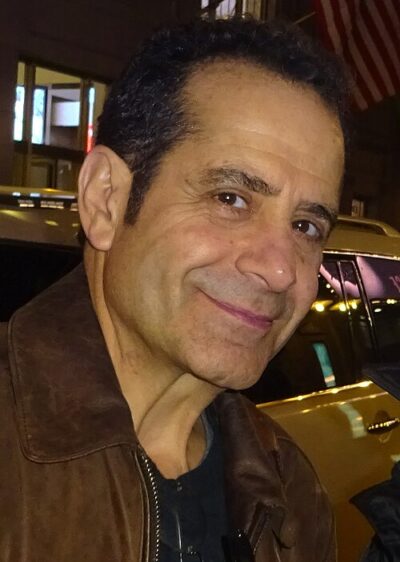
Tony Shalhoub
Tony Shalhoub is an American actor. Born October 9, 1953, in Green Bay. Known for Fallout. Educated at Yale School of Drama and University of Maine. Awards include Golden Globes, National Society of Film Critics Award for Best Supporting Actor and Screen Actors Guild Award for Outstanding Performance by a Male Actor in a Comedy Series (2 times).
Facts
28 facts · 1 confirmed by two sources · 3 cited · 24 from one source
Where this comes from
Papalocal keeps its own record. It started from these sources; what each one said is kept here as it was copied, so a change on their side never changes this page by itself. Tap one to read its version.
What Wikipedia says · copied November 13, 2026 · revision 1385107138
Anthony Marc Shalhoub ( shəl-HOOB; Arabic: أنطوني مارك شلهوب; born October 9, 1953) is an American actor and filmmaker. He is known for a variety of roles ranging from comedic to dramatic on stage and screen. He has received several accolades including five Emmy Awards, a Golden Globe Award, six Actor Awards and a Tony Award as well as a nomination for a Grammy Award.
His breakout role was as Antonio Scarpacci on the NBC sitcom Wings from 1991 to 1997. He later starred as Adrian Monk in the USA Network series Monk (2002–2009), winning three Primetime Emmy Awards for Outstanding Lead Actor in a Comedy Series as well as the Golden Globe Award for Best Actor in a Comedy Series. For his supporting role as Abe Weissman, a professor turned activist and critic in the Amazon period comedy-drama The Marvelous Mrs. Maisel (2017–2023), he won the Primetime Emmy Award for Outstanding Supporting Actor in a Comedy Series.
Shalhoub has starred in films such as Quick Change (1990), Barton Fink (1991), Big Night (1996), Men in Black (1997), Gattaca (1997), Paulie (1998), The Siege (1998), Galaxy Quest (1999), Spy Kids, Thirteen Ghosts, and The Man Who Wasn't There (all 2001). He has voiced roles for the Cars franchise (2006–present), Teenage Mutant Ninja Turtles (2014), Teenage Mutant Ninja Turtles: Out of the Shadows (2016) and Rumble (2021).
On stage, he made his Broadway debut in a revival of The Odd Couple (1985). He went on to win the Tony Award for Best Actor in a Musical for his portrayal of Tewfiq Zakaria in The Band's Visit (2018). He was Tony-nominated for his performances in the Herb Gardner play Conversations with My Father (1992), the Clifford Odets play Golden Boy (2013), and the James Lapine play Act One (2014).
- Born, in its opening lines
- October 9, 1953
From the Wikipedia article “Tony Shalhoub” (en.wikipedia.org/wiki/Tony_Shalhoub), by its contributors, under CC BY-SA 4.0 (creativecommons.org/licenses/by-sa/4.0/). Copied November 13, 2026; not changed.
What Wikidata says · copied November 14, 2026 · revision 2569035872
- Described as
- American actor (born 1953)
- Other names
- Anthony Marc Shalhoub
- Born
- October 9, 1953 · 3 references
- Born in
- Green Bay · 1 reference
- Name at birth
- Anthony Marcus Shalhoub
- Citizen of
- United States
- Occupation
- film director; dub actor; film producer · 2 references; television producer · 1 reference; film actor; stage actor; television actor; voice actor
- Education
- Yale School of Drama; University of Maine; University of Southern Maine; Green Bay East High School · 1 reference; University of Wisconsin–Green Bay · 1 reference
- Known for
- Fallout
- Awards
- Golden Globes; National Society of Film Critics Award for Best Supporting Actor (1996); Screen Actors Guild Award for Outstanding Performance by a Male Actor in a Comedy Series (2 times) (2004, 2005); Primetime Emmy Award for Outstanding Supporting Actor in a Comedy Series (2019); Primetime Emmy Award for Outstanding Lead Actor in a Comedy Series (3 times) (2003, 2005, 2006)
- Spouse
- Brooke Adams (1992–)
- Siblings
- Michael Shalhoub
- Lived in
- Wisconsin; Green Bay
- Nickname
- Tony Shalhoub
- Wikipedias with a page
- 51
Wikidata item Q107249 (wikidata.org/wiki/Q107249), public domain (CC0). Copied November 14, 2026.
Confirmed Two sources agree. Cited One source, and it names where it got it. One source One source, without a reference of its own. Sources disagree The sources disagree. We show the best-supported value and keep theirs below.
