
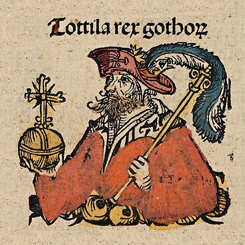
Totila
Totila was a king of the Ostrogoths and King of Italy. Born 510, in Treviso. Died 552, in Gualdo Tadino. Positions held include King of the Ostrogoths (541–552).
Facts
8 facts · 1 confirmed by two sources · 1 cited · 6 from one source
Where this comes from
Papalocal keeps its own record. It started from these sources; what each one said is kept here as it was copied, so a change on their side never changes this page by itself. Tap one to read its version.
What Wikidata says · copied November 16, 2026 · revision 2546706576
- Described as
- king of the Ostrogoths and King of Italy (541–552)
- Other names
- Baduila, Baduila, -552, Totila, Gotenkönig, -552, Totila, King of the Ostrogoths, d. 552
- Born
- 510
- Died
- 552 · 1 reference
- Born in
- Treviso
- Died in
- Gualdo Tadino
- Citizen of
- Ostrogothic Kingdom
- Occupation
- monarch · 1 reference
- Positions held
- King of the Ostrogoths (541–552)
- Religion
- Arianism
- Wikipedias with a page
- 50
Wikidata item Q159707 (wikidata.org/wiki/Q159707), public domain (CC0). Copied November 16, 2026.
What Wikipedia says · copied November 16, 2026 · revision 1380935731
Totila, original name Baduila (died 1 July 552), was the penultimate King of the Ostrogoths, reigning from 541 to 552. A skilled military and political leader, Totila reversed the tide of the Gothic War, recovering by 543 almost all the territories in Italy that the Eastern Roman Empire had captured from the Ostrogothic Kingdom in 540.
A grandnephew of Theudis, sword-bearer of Theodoric the Great and king of the Visigoths, Totila was elected king by Ostrogothic nobles in the autumn of 541 after the deaths of two former Ostrogothic kings, Ildibad and Eraric. Both had been killed by the Gothic nobility for attempting to surrender to the Romans. Totila proved himself both as a military and political leader, winning the support of the lower classes by liberating slaves and distributing land to the peasants. After a successful defence at Verona, Totila pursued and defeated a numerically superior army at the Battle of Faventia in 542. Totila followed these victories by defeating the Romans outside Florence and capturing Naples. By 543, fighting on land and sea, he had reconquered the bulk of Rome's southern territories, but not the capital. Rome still held out, and Totila appealed unsuccessfully to the Senate in a letter reminding them of Rome's loyalty to his predecessor Theodoric the Great. In the spring of 544, the Eastern Roman emperor Justinian I sent general Belisarius to recapture Italian territory, but Totila captured Rome in 546 from Belisarius, which was depopulated after a yearlong siege. When Totila left to fight the Byzantines in Lucania, south of Naples, Belisarius retook Rome and rebuilt its fortifications.
After Belisarius retreated to Constantinople in 549, Totila recaptured Rome again and went on to complete the reconquest of Italy and Sicily. By the end of 550, Totila had recaptured nearly all of his previous territorial possession; however, Ravenna and four coastal towns remained under Byzantine control. The following year Justinian sent his general Narses with a force of 35,000 Lombards, Gepids, and Heruli to Italy in a march around the Adriatic Sea; these combined forces approached Ravenna from the north. During the Battle of Taginae, a decisive engagement in the Apennines near present-day Fabriano, the Gothic army was defeated and Totila was mortally wounded. Totila was succeeded by his relative Teia, who later died at the Battle of Mons Lactarius. Pockets of resistance, reinforced by Franks and Alemanni who had invaded Italy in 553, continued until 562, at which point the Byzantines gained control of the country following Justinian's conquests.
- Died, in its opening lines
- July 1, 552
From the Wikipedia article “Totila” (en.wikipedia.org/wiki/Totila), by its contributors, under CC BY-SA 4.0 (creativecommons.org/licenses/by-sa/4.0/). Copied November 16, 2026; not changed.
Confirmed Two sources agree. Cited One source, and it names where it got it. One source One source, without a reference of its own. Sources disagree The sources disagree. We show the best-supported value and keep theirs below.
